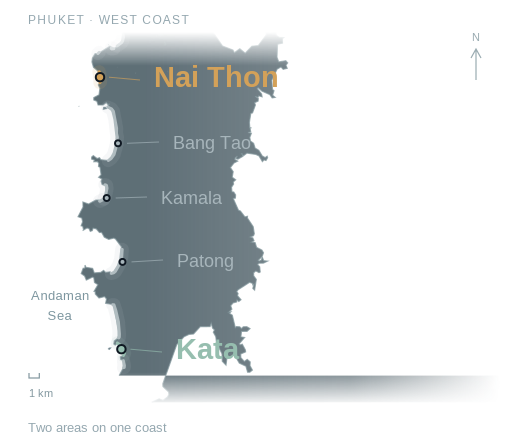
Kata and Nai Thon are on the same west coast of Phuket, but at opposite ends: Kata in the southwest, Nai Thon in the northwest, with Karon, Patong, Kamala, Surin, Bang Tao and Layan between them. By road it is about 38 kilometres, around 45 minutes without traffic.
Kata is a small resort: the beach, markets, cafés and bars are within a kilometre, with new condos rising up the hills. Nai Thon is a small bay of about a kilometre between two headlands, with a beach in Sirinat National Park and a village along the road above it, 10 minutes from the airport. So Kata is chosen to have everything close by, and Nai Thon for a quiet beach, though you cannot do without a car there.
First, we look at where both areas came from: what was here before the tourists and how each one became what it is today. Without that, it is hard to see why they are so different.
Then we look at them as they are now: how they are laid out, what an ordinary day looks like for a resident, and where the areas are heading — what is being built and how that will change them over the next few years.
At the end come the conclusions: which area suits whom, what is known about rental returns, how to buy without overpaying, and whom to contact to check a specific property.
1. Kata’s backstory
Kata is an old village. Officially it is Ban Kata, village No. 2 of Karon subdistrict. Nobody knows exactly where the name comes from; locals tell two legends. In one, the guardian spirit of the area dried rice on the plain by the hill, and “to dry” sounds like “ta” in the local dialect. In the other, the word comes from “Krata”, a “rice bay”.
Rice fields, pastures and forested hills used to cover this land. The main temple, Wat Kata, was built around 1832 according to the temple’s own history — almost 80 years before the temple in Karon.
The first visitors stayed right in the village: local families rented them rooms, as there were no guesthouses yet. Large hotels arrived in the 1980s. The first, in November 1984, was Katathani in Kata Noi bay — 44 bungalows. Around the same time Club Med appeared on Kata Beach: it was the first project of local entrepreneur Mom Tri. He built his own house on the hill between Kata and Kata Noi, and over time the house grew into the Villa Royale hotel. And on 9 February 1989 the Boathouse hotel opened on the beach.
The 2004 tsunami flooded the 300-room Club Med and the ground floors of the beachfront hotels; Kata Noi was hit too. But buildings behind the beachfront were barely damaged, and no hotel closed for more than a few weeks.
Today Kata is also known for surfing: the rainy season brings good waves. In 2009 Kata hosted the final of Thailand’s first international Quiksilver series, and in 2022 an international surfing festival.
New houses here are climbing the hills too. In August 2024, after a night of heavy rain, a landslide came down from the hill near the Big Buddha onto Soi Patak 2 in Kata village. Thirteen people died.
2. Nai Thon’s backstory
Nai Thon is one of the old villages of Sakhu subdistrict in northwest Phuket. According to the local administration, there was once a large pond here where cattle were watered — “sra kho” — and the name Sakhu comes from it. The subdistrict had four villages: Nai Yang, Trok Muang, Sakhu and Nai Thon. It also has two beaches — Nai Thon and Nai Yang.
In 1981 the coast around the airport was declared a national park — first called Nai Yang, and Sirinat since 1992. Nai Thon Beach is part of the park, while the village stretches along the road above the beach. In 2016 a former head of the national parks department stated that about 1,200 rai of Sirinat land had been removed from the park and title documents had been illegally issued for the plots. So before buying here it is especially important to check the plot boundaries and land documents.
The resort village here is small. Along the road above the beach, local residents run cafés, stalls with food, clothes and souvenirs, and massage places, with hotels and a taxi stand nearby. The Pullman Phuket Arcadia hotel stands on the northern headland, Malaiwana villas on the southern one, and condominiums have grown up behind the road.
The beach changes with the seasons. From May to September monsoon waves churn the sand: they bring in new sand and carry it away from the water’s edge. So in high season, from October to April, the sand is white and fine, while in the rainy season the beach looks different.
3. Kata on the map: what is where
Kata is a small bay south of Karon: the beach is about 1.4 kilometres long, and beyond the headland to the south is the little Kata Noi bay, about 0.7 kilometres. Officially Kata is part of Karon subdistrict. From here it is about 3 kilometres to the centre of Karon, about 5 to Chalong and about 8 to Patong in a straight line.

From the sea inland, the area is laid out like this:
By the water — Kata Beach. Club Med takes up the middle of it, closer to the north end, with other hotels and cafés at the edges. Opposite the beach lies Koh Pu island.
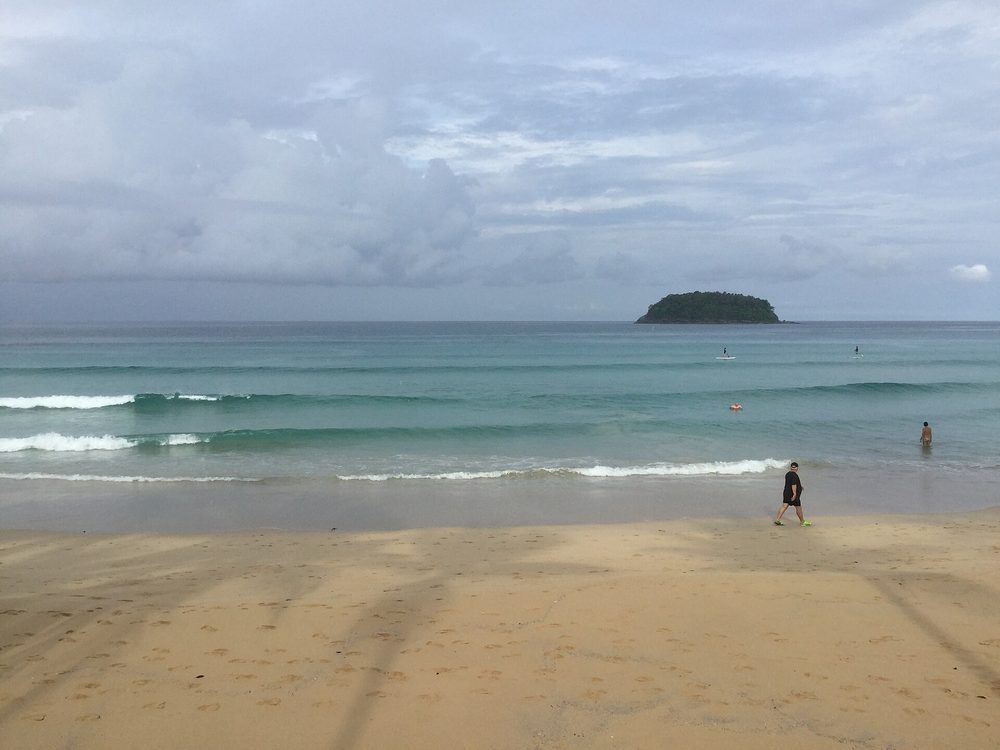
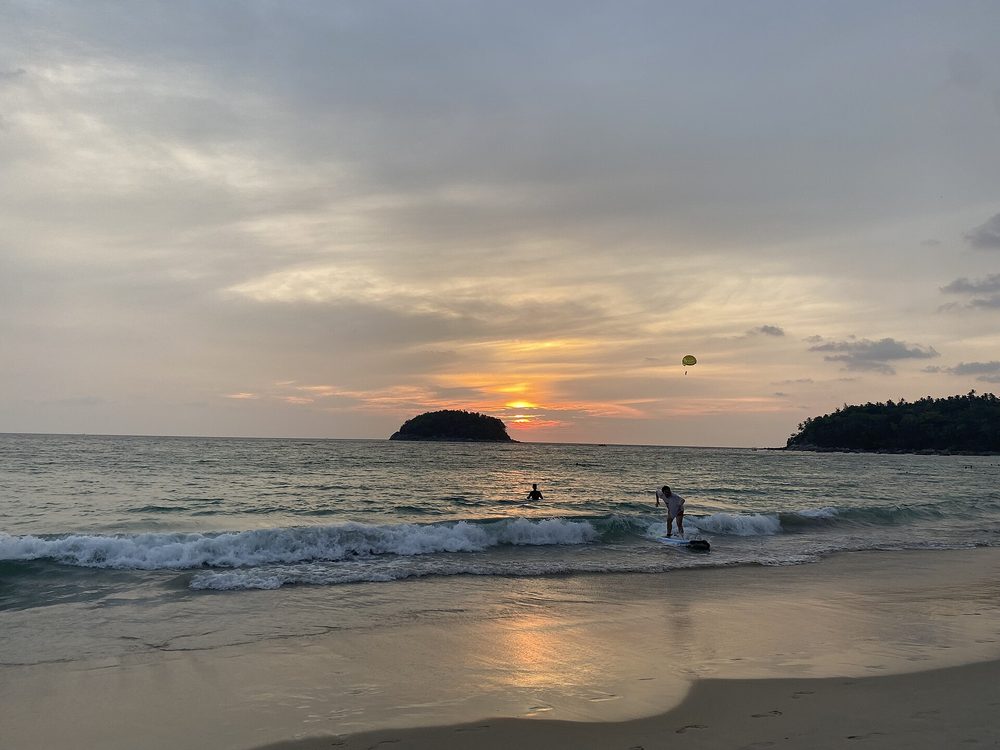
The centre — around the roundabout, about 400 metres from the sea: two markets, a night market, Kata Night Plaza, a Lotus’s supermarket, mini-marts and clinics. All within a kilometre of the beach.
A little further from the sea, about a kilometre away, are the Wat Kata temple and the Thai school Baan Kata.
The slopes — villas and apartments with sea views on the hills around the bay. Highest of all, about 2 kilometres from the beach, stands the Big Buddha.
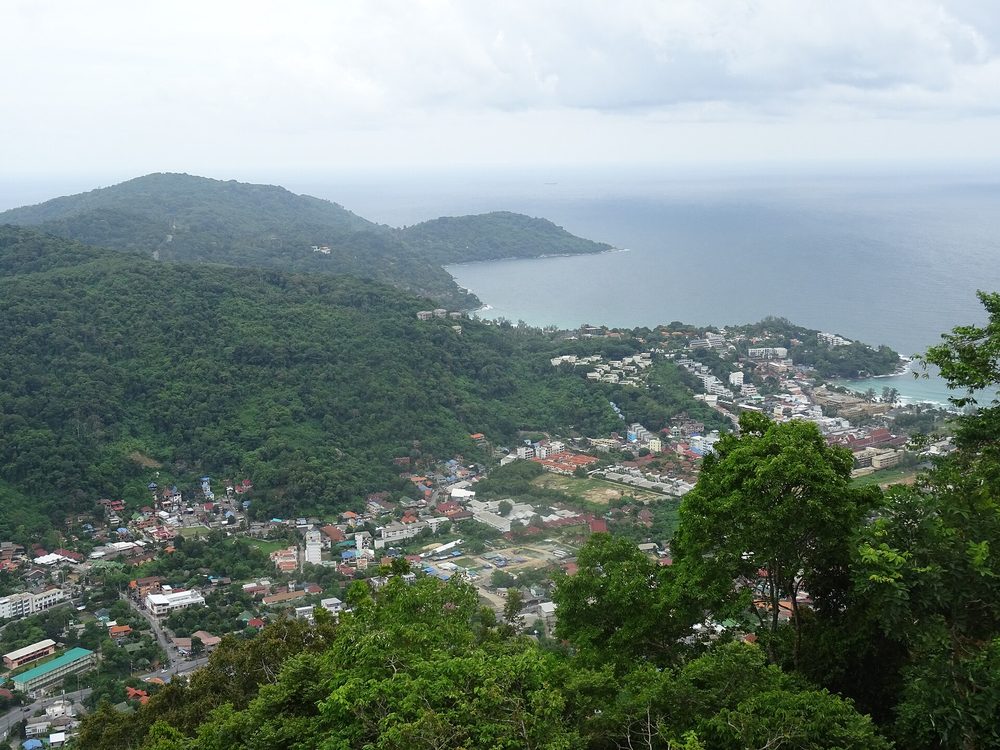
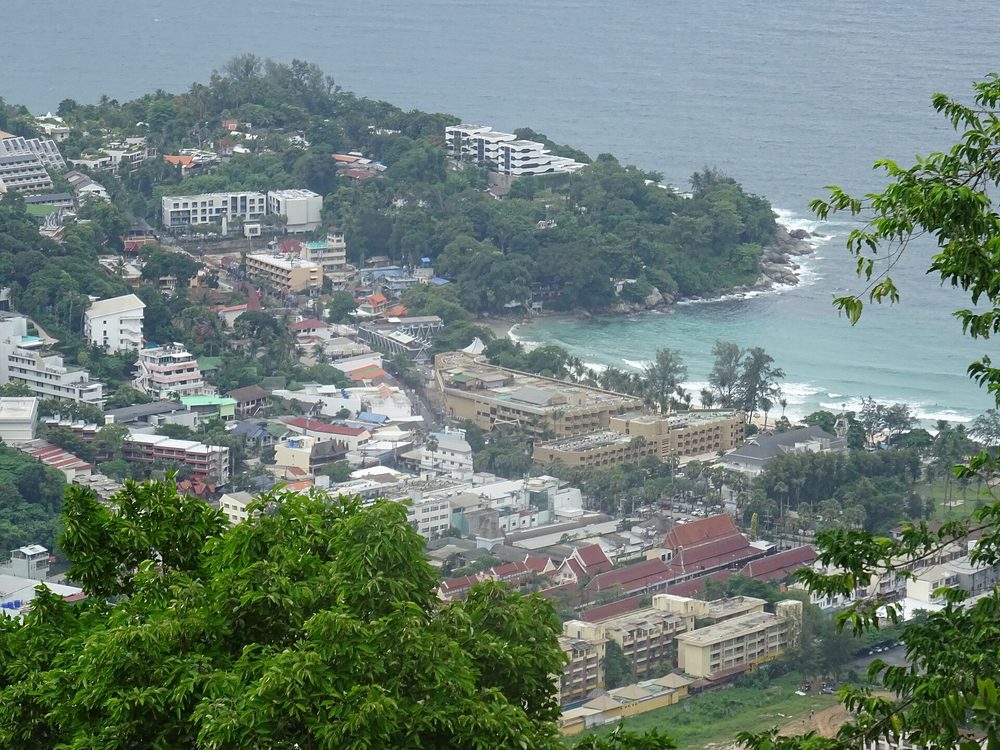
To the south — beyond the headland, the quiet Kata Noi bay with the Katathani hotel, and further along the road the Karon Viewpoint.
Kata is small, and its low-lying part is easy to walk: from the beach to the markets is about ten minutes. Walking down from the hills is easy, but climbing back up is hard — there you need a scooter or a taxi.
Glossary
What the names in listings mean
| Name | What it actually is |
|---|---|
| Kata | The beach and the village. Listings often give the address as “Karon”, because Kata is part of Karon subdistrict. |
| Kata Noi | A separate small bay beyond the headland south of Kata. |
| Kata Palm | The Phuket Smart Bus stop in Kata. |
| Big Buddha | The Buddha statue on the hill above Kata and Karon; the slopes next to it have villas. |
4. Nai Thon on the map: what is where
Nai Thon is a small bay in northwest Phuket between two headlands, with a beach of about a kilometre. Officially it is the village of Ban Nai Thon in Sakhu subdistrict, Thalang district, and the beach itself is part of Sirinat National Park. The airport is about 8 kilometres away, 9–11 minutes by car, and Patong 28–30 kilometres.

From the sea inland, the village is laid out like this:
By the water — a beach of about a kilometre lined with pines and pandanus. The beach is part of Sirinat National Park. The Pullman Arcadia hotel is on the northern headland, and a long wooden stairway leads down to the southern end of the beach — one of the most popular photo spots.
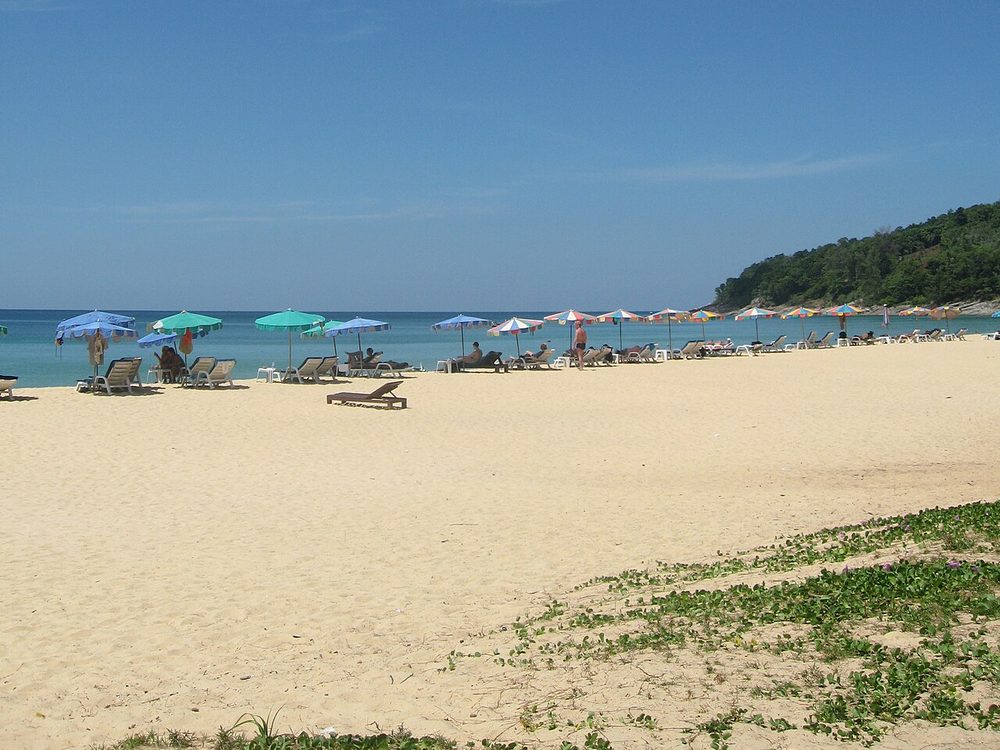
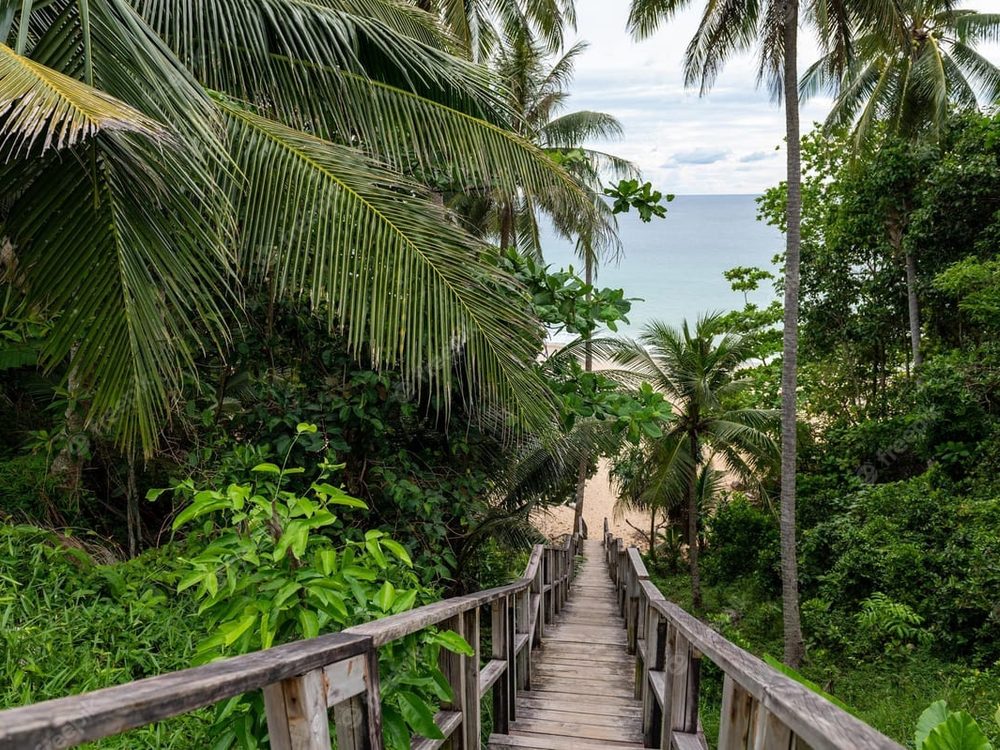
Along the road above the beach — the village itself: cafés and restaurants, massage, local stalls, Naithon Mart and Tops Daily mini-markets, a 7-Eleven, a pharmacy, an ATM, a taxi stand and small hotels. Ban Nai Thon, a Thai school, is here too.
Behind the road and on the slopes — The Naithon Condominium, Sea Heaven, Pearl of Naithon and Saint Tropez Naithon condominiums, and on the headlands and hills — Malaiwana, Phuvista and Vista del Mar villas. Cheaper villa estates are further away, 2.5 kilometres from the beach.
To the south — the small Nai Thon Noi and Banana beaches, and then the road continues to Layan and Bang Tao.
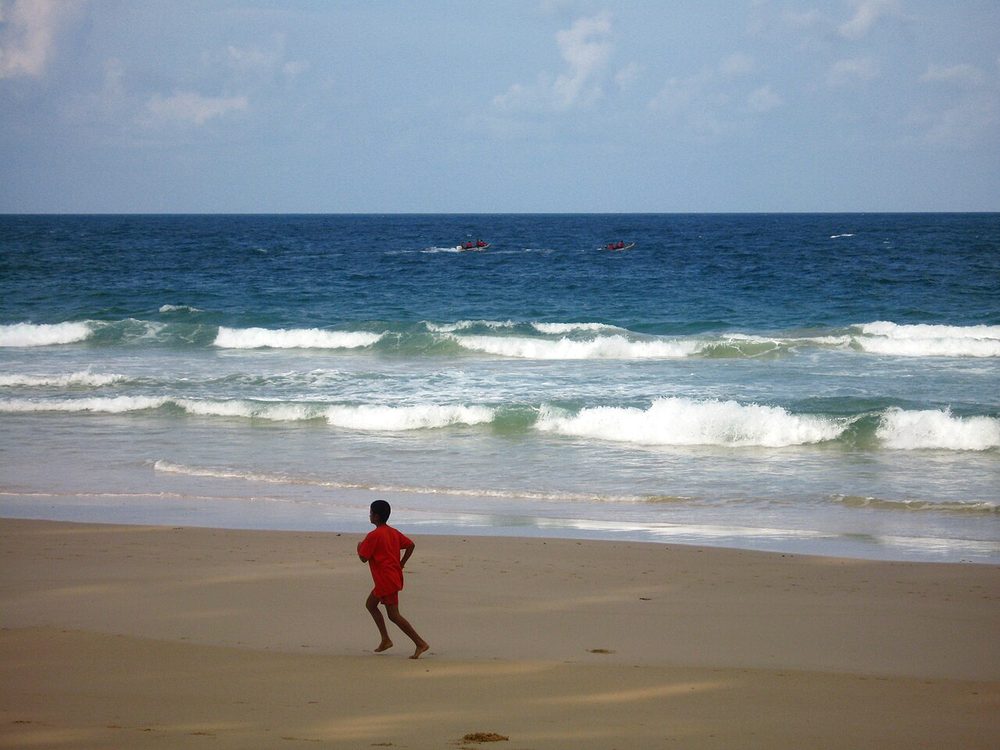
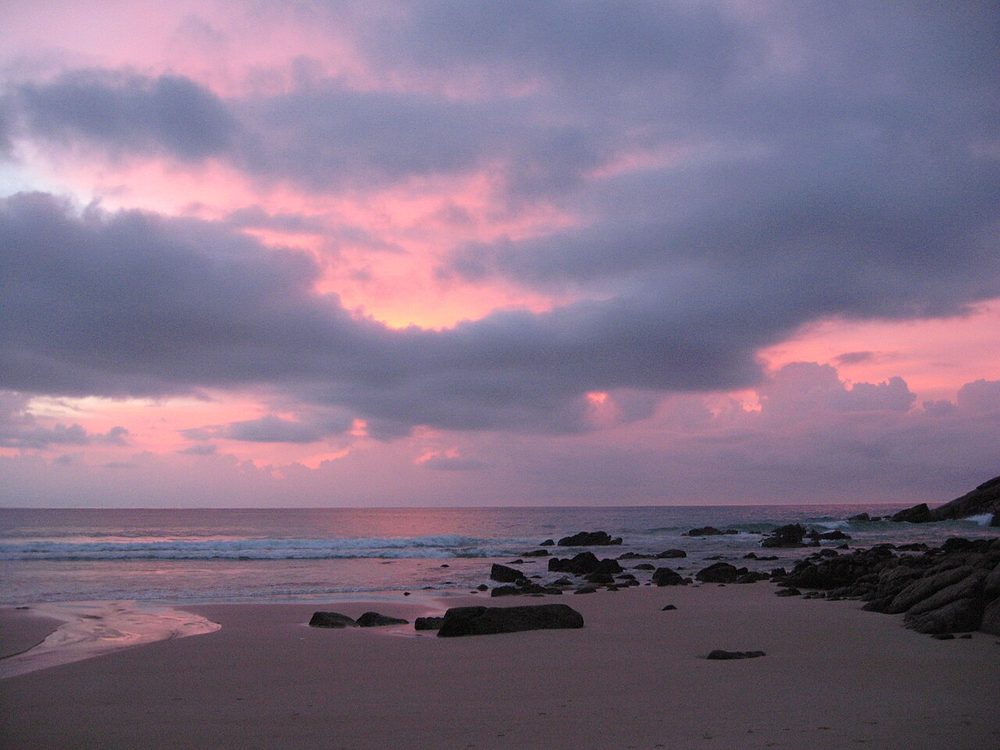
The village is small and walkable. But for a market, a big supermarket or a doctor, people drive to Nai Yang, about 6 minutes by car, and to Thalang.
Glossary
What the names in listings mean
| Name | What it actually is |
|---|---|
| Nai Thon, Naithon, Nai Ton | The beach and the village. Spelled differently, it is the same place. |
| Sakhu, Sa Khu | The subdistrict Nai Thon belongs to. It also includes Nai Yang by the airport, so “Sakhu” in a listing does not necessarily mean Nai Thon. |
| Near Naithon Beach | A common tag. Check the distance in the listing: some villa estates are 2.5 kilometres from the beach. |
| Sirinat (Sirinath) National Park | A national park along Nai Thon, Nai Yang and Mai Khao beaches. Plot boundaries near the park are checked against the land documents. |
5. A day in Kata and in Nai Thon
Let’s walk through an ordinary day in both areas — from the walk to the sea in the morning to the quiet at night.
Morning: getting to the sea
Kata. From the centre to the beach is about 400 metres, a 5-minute walk. From the hills people come down by scooter or car. From May to October Kata has big waves: surfers come then, and you should only swim where the lifeguards allow it.
Nai Thon. From the village the beach is a few minutes’ walk: the village sits on the road right above the shore, and a wooden stairway leads down to the southern end of the beach. In the morning the beach is quiet, shaded by pines and pandanus.
Children: kindergarten and school
Kata. For children there is the British school BCIS in neighbouring Chalong, which takes children from 2 to 18. The school itself says Kata Beach is 15–30 minutes away. A year of schooling in 2026/27 costs from 302,000 baht in Nursery–Reception to 502,500 baht in Year 12–13.
Nai Thon. The village has a Thai school, Ban Nai Thon. The nearest international school is UWC Thailand in Thalang, about 16–19 minutes without traffic. Tuition in 2026/27 ranges from 345,000 baht a year in preschool and 753,500 in Grades 1–5 to 933,000 in the senior grades. On admission, a family with one child also pays 272,000 baht in non-refundable fees.
Errands: shops, market, doctor
Kata. Everything for daily life is around the central roundabout: two markets, a night market, Lotus’s, mini-marts and clinics, within a kilometre of the sea. The big supermarket and DIY stores are in Chalong, about 5 kilometres away. The road to the big hospitals also runs through Chalong: they are in Phuket Town, the island’s main town, about 12 kilometres away in a straight line.
Nai Thon. The village has Naithon Mart and Tops Daily mini-markets, a 7-Eleven and a pharmacy. For a market and Big C people drive to Nai Yang, about 6 minutes. The public Thalang Hospital is about 15 minutes by car, the private Bangkok Hospital Phuket 32–36 minutes.
Getting around the island
Kata. The Phuket Smart Bus from the airport runs along the west coast and stops in Kata at Kata Palm; a ticket costs 100 baht. The centre of Karon is about three kilometres away, Chalong about five.
Nai Thon. The airport is 9–11 minutes away without traffic — the main advantage for frequent flyers. The Phuket Smart Bus runs from the airport along the west coast, but its route description has no stop at Nai Thon Beach; there is a taxi stand by the beach. Patong is 32–37 minutes away.
Evening
Kata. In the evening — the night market and Kata Night Plaza near the centre, restaurants by the beach and sunset over the sea with Koh Pu island.
Nai Thon. In the evening — sunset over the bay, restaurants along the road above the beach and hotel bars. There is no nightlife: for that people go to Patong.
Night and quiet
Kata. It is quietest on the hills and away from the centre, noisier near the night market and the beach bars. There is construction on the slopes.
Nai Thon. At night it is quiet, with no bars playing loud music. During the day it is noisier by the road above the beach, with traffic and cafés.
And in the rainy season
Kata. From May to October the beach has big waves and red flags, but this is the surfing season. In heavy downpours the low-lying areas flood. And the main risk is the slopes: the 2024 landslide came down in Kata itself.
Nai Thon. In the rainy season, roughly from May to October, high waves and rip currents hit the shore, and swimming is forbidden when the red flag is up. This is not a formality: in May 2026 a man went into the water under a red flag and drowned. The sand is carried away from the water’s edge at this time, and the beach looks different.
In short
A typical day compared
| Kata | Nai Thon | |
|---|---|---|
| To the sea | About 400 m on foot from the centre; from the hills — by transport | A few minutes’ walk from the village |
| Children | BCIS in Chalong — 15–30 minutes | Thai school in the village; UWC — 16–19 minutes |
| Shops and doctor | Markets, Lotus’s and clinics in the centre; big stores in Chalong | Mini-markets in the village; Big C — 6 minutes, Thalang Hospital — about 15 |
| Transport | Bus stop at Kata Palm; Chalong about 5 km away | Airport 9–11 minutes away; everything else by car |
| Evening | Night market, Kata Night Plaza, beach restaurants | Sunset, restaurants above the beach |
| Noise | Near the centre and bars; construction on the slopes | Quiet at night; noisier by the road during the day |
| Rainy season | Waves and surfing season, flooding in low-lying areas, landslides on the slopes | Waves and red flags in the rainy season |
6. Where the areas are heading
Looking back at where both areas came from also explains how they are growing now. Both are growing upwards: in Kata new developments rise up the hills around the bay, and in Nai Thon housing is built behind the road above the beach and on the slopes.
Kata is growing on the hills
Kata’s biggest new project is SO Origin Kata: according to the developer’s brochure, 686 apartments in four eight-storey buildings, with completion planned for 2027. Phenomenon Residence is being built nearby — 293 apartments, according to the developer. On the beach, Club Med has been renewed: it reopened in 2022 after a major renovation.
Nai Thon grows on the slopes
New housing is being built behind the road above the beach and on the slopes. The largest project is Sea Heaven: listings sell units in its second and third phases, and on its website the developer promises a whole quarter with hotels, shops, sports and a medical centre. For now this is a concept, not completed buildings. Nearby, units are on sale at Saint Tropez Naithon and villas at Phuvista Naithon.
The airport is nearby and growing: Airports of Thailand promises to finish expanding the international terminal and aircraft stands by 2031 and to raise capacity to 18 million passengers a year.
7. What is for sale here
In both areas, essentially two things are sold: apartments and villas. The difference between them is not just size, but what exactly you end up owning.
Apartment
Apartments are sold in residential complexes — in Thailand such a building is called a condominium. A complex usually has a shared pool, gym and security, and a management company keeps things in order.
A foreigner can register an apartment in their own name outright and permanently — this is called freehold. There are usually two main conditions. First, foreigners may own no more than 49% of the total floor area of all units in a building, so before buying you check whether the foreign quota is still available. Second, the money for the purchase comes from abroad, and the bank issues a certificate confirming this. There are other legal routes — for example, Thai permanent residence — but most buyers go this way.
Villa
A villa is a detached house with its own plot, usually with a private pool. This is more complicated: as a rule, a foreigner cannot buy land in Thailand in their own name. So the land is most often taken on a long-term lease, usually 30 years — this is called leasehold — and the house itself is registered separately. The law does not guarantee renewal of the lease after 30 years; it is written into the contract.
In short: a foreigner usually buys an apartment freehold, sometimes on a long lease. A common arrangement for a villa is a long-term land lease, with rights to the house registered separately. The terms depend on the property. That is neither better nor worse, but a villa’s documents need closer checking.
What is sold where
In Kata condos are sold in developments near the centre and on the hills — for example Kata Ocean View, SO Origin Kata, The Beach Condotel — while villas stand on the slopes around the bay and near Kata Noi. In Nai Thon condos are sold in a few developments behind the road above the beach and on the slope — The Naithon Condominium, Sea Heaven, Saint Tropez Naithon, Pearl of Naithon. Sea-view villas stand on the headlands and hills — Phuvista, Vista del Mar, Malaiwana — while cheaper villa estates, such as Sra Villas and Aileen Villas, are 2.5 kilometres from the beach. In both areas some apartments and villas are sold as leasehold, a long-term lease rather than ownership — check this before buying.
Prices
Below are real listings for October–November 2026. These are asking prices, not transaction prices, and the sample is small, so look at the order of magnitude rather than the exact figures.
Prices
Sample listings for sale
| Kata | Nai Thon | |
|---|---|---|
| Small apartment | 2.85–6.55 million baht for 26–53 m²: from 75,000 to 170,000 baht per m² | Studios and small apartments of 30–49 m² — 3.5–8 million baht (84,000–208,000 baht per m²). Listings often confuse studios with one-bedroom apartments, so check the floor plan |
| Larger apartment | 2 bedrooms, 65–154 m² — 5.5–19.8 million baht (73,000–162,000 baht per m²) | 2 bedrooms, 50–117 m² — 5.2–15 million baht (105,000–185,000 baht per m²) |
| Villa | 3 bedrooms, 225 m², Mali Thai Pool Villas — 19.9–28.9 million baht in listings as of 19.11.2026; check the form of land ownership for each villa | 3 bedrooms, 204–418 m² — 12.8–39.8 million baht: from 12.8 million 2.5 km from the beach, from 32 million by the sea |
Price depends heavily on how new the building is, the view and how far it is to the sea. So compare properties of the same type and with the same form of ownership.
8. Money: costs, renting, living and resale
Buy to rent, live here yourself or do both. First, let’s look at what you will pay either way.
What you will pay
A condo comes with a mandatory monthly fee for the upkeep of the building: pool, cleaning, security. For example, at Kata Ocean View and VIP Kata listings state a fee of about 60 baht per m² a month — 2,400–3,000 baht for a 40–50 m² apartment. In Nai Thon, at Sea Heaven, it is also 60 baht per m²: 1,860 baht a month for a 31 m² studio. When receiving the keys in a new building, buyers also make a one-off payment into the building’s sinking fund. A villa may also have shared fees, plus the cost of maintaining the pool and garden and paying for repairs.
Long-term rental
A one-year contract: the tenant pays monthly and covers electricity and water. Rental income is lower, but managing the property is simpler and more predictable: you do not have to find new guests every few days.
For example, listings for autumn 2026. In Kata: a 30 m² one-bedroom — 18,000 baht a month, a one-bedroom at Kata Top View — 30,000 baht, a three-bedroom villa — about 98,000 baht, with cleaning, garden and pool already included. In Nai Thon there are few listings and their rents are high: a 33 m² studio at The Naithon Condominium — 50,000 baht a month on a one-year lease, a two-bedroom at Pearl of Naithon — 60,000–95,000 baht. Rents depend heavily on the building and the season, so the real figure is best checked against 5–10 similar listings in your chosen spot.
Short-term rental
Guests come for a few days, as to a hotel. They pay more per night, but the property often stands empty, especially in the rainy season. AirROI, which collects Airbnb data, counts Kata and Karon together as one area: over the past year properties there were booked on about 41% of nights. In Sakhu subdistrict, which includes Nai Thon, it is about 35%, with no separate data for Nai Thon. Seasonality in Sakhu is strong: according to AirROI, in January 2026 average revenue per active listing there was about 5.7 times higher than in September, before expenses. So calculate the yield for the specific property together with the purchase price and expenses.
Something else matters too: under Thai law, renting an apartment out by the night counts as running a hotel, and it is not allowed everywhere without a licence. On top of that, every complex has its own rules — some ban short-term rentals. This is checked before buying.
If you rent through a management company rather than yourself, it takes a share of the income, and rates and services vary widely between companies. The booking platform takes its own commission too: under the single-fee model, most hosts pay Airbnb 15.5%. So the owner receives noticeably less of the nightly rate than the listings suggest — before buying, ask the management company for a net-income calculation.
Live here yourself
In Kata the beach, markets and centre are within a kilometre and much is walkable, and BCIS school in Chalong is 15–30 minutes away. In Nai Thon the beach is a few minutes away, it is quiet and the airport is 10 minutes away, but the village has only mini-markets and cafés: for a market, a supermarket or a doctor people drive to Nai Yang and Thalang.
Beyond the complex fee, the main cost is electricity, mostly air-conditioning. And while you are away, someone has to look after the apartment: in the rainy season it needs airing and checking for leaks. A management company usually takes care of this.
Live here part of the year and rent it out
What matters is which months you come. Homes rent best from November to April; in the rainy season, from May to October, there are fewer guests. If you live here in winter, you will be renting out in the weak months, and income will be well below the annual figure. If you come in summer and rent out in winter, it works out better.
While you are away, you can let the apartment for a few months at a time or by the night. For nightly rentals, check the licence and the complex’s rules in advance; check-ins are usually handed to a management company.
Resale
In Kata you will be selling alongside new projects on the slopes, including the large SO Origin. In Nai Thon buyers are few, and you will be selling alongside dozens of new units from the Sea Heaven and Saint Tropez Naithon developers.
9. Choosing by goal
Choice
Choosing by goal
| Goal | Better fit | Why |
|---|---|---|
| Living with school-age children | No clear winner | From Kata the British school BCIS in Chalong is 15–30 minutes away. From Nai Thon UWC Thailand in Thalang is 16–19 minutes away, and HeadStart in Choeng Thale about 18 minutes without traffic. |
| Living with young children (under 7) | Leans towards Kata | The beach, markets and clinics are within a kilometre, and BCIS takes children from age 2. But from May to October there are big waves on the beach. Nai Thon is quiet, but it also has waves in the rainy season, and people drive to Nai Yang for shopping. |
| Living as a couple or alone, without children | Depends on your lifestyle | Kata — a small resort with the beach, markets and bars close by. Nai Thon — a quiet beach and nature, but almost nothing to do in the evenings. |
| Living without a car | Kata | The beach, markets, a supermarket and clinics are within a kilometre, and the airport bus stops at Kata Palm. In Nai Thon you cannot get beyond the village without a car or scooter. |
| Flying often | Nai Thon | The airport is 9–11 minutes away. From Kata — about 55 minutes without traffic. |
| Wintering for a few months | Depends on taste | Kata — a resort with cafés and shops; other southern beaches are nearby. Nai Thon — a small beach by a national park where people come for the quiet. |
| Surfing | Kata | From May to October Kata has waves, and surfing competitions are held here. |
| Quiet | Leans towards Nai Thon | No bars with loud music, quiet at night. Kata is quieter on the hills and noisier near the night market and bars, with construction on the slopes. |
| Long-term rental | No clear winner | One-bedroom apartments in Kata rent for 18,000–30,000 baht a month in our examples. In Nai Thon there are few listings and rents are higher, but buying an apartment there also costs more. |
| Short-term rental | No clear winner | According to AirROI, about 41% of nights in Kata and Karon and 35% in Sakhu, which includes Nai Thon. Seasonality is stronger in Sakhu: calculate income for the specific property. |
| Smallest budget | Leans towards Kata | In Kata a one-bedroom at Kata Ocean View, 1.5 km from the beach, costs 2.85 million baht as leasehold (the card and the seller’s description give different areas: 38 and 36 m²), and a 36.7 m² one in the same development under the foreign quota 2.95 million. In our sample, similarly priced options in Nai Thon are studios: 3.5 million listed as Thai quota and leasehold, and 3.75 million under the foreign quota. These are listing prices; availability is confirmed by the seller. |
10. How a purchase works and what to check
Buying in Thailand is simpler than it seems, but several parties are involved: the agent, the lawyer, the bank and the land office. Here is how it usually goes, step by step.
1. Search: developer or agent
A new apartment is bought from the developer — directly or through an agent. In that case the developer usually pays the agent’s commission, but it is still worth comparing the price and promotions with the developer’s direct offer before reserving. A resale home from a private owner is almost always sold through an agency. Here too the seller usually pays the commission, most often 3–5% of the price, but terms vary, so ask about it straight away.
2. Viewing
Many people first view properties by video, but it is better to see the chosen home yourself or send someone you trust: the walk to the sea, noise and nearby construction do not show up on video. What exactly to check on site is in the list below.
3. Your own lawyer
This is the key step, and it starts before any money changes hands. You hire the lawyer yourself; they must not work for the seller or the agent. First they read the reservation terms: who receives the money and when it is refunded. Then, at the land office, they check the title deed, debts and encumbrances, the building permit and whether the building still has foreign quota available, and they read the contract. For a villa, they also check the land lease: its term, the renewal conditions and what happens to the house.
4. Reservation
Once the lawyer has seen the terms, you pay a small reservation deposit — the seller takes the property off the market while the full check is done. The amount and the refund terms are set out in the reservation agreement.
5. Contract and payment
Next, the sale and purchase agreement is signed. A new build is usually paid for in instalments as construction progresses; for a finished home, the buyer pays a deposit at signing and the balance at registration. The money is transferred from abroad to a Thai account, stating property purchase as the purpose of payment. The bank issues a transfer certificate — if the apartment is registered on this basis, it cannot be done without it.
6. Registration
The provincial land office registers either the ownership or the long-term lease. You do not have to attend in person: a lawyer can do it under a power of attorney. Fees are paid here too: 2% of the appraised value for the transfer (the contract decides who pays, often split in half). Most often the seller also pays income tax and 0.5% stamp duty, or, if selling within five years of buying, a 3.3% specific business tax instead of stamp duty. If you are leasing land for a villa, the lease agreement is registered, with a fee of about 1% of the total rent for the whole term. There are exceptions, so it is best to work out the amount for your deal with a lawyer in advance.
7. Keys
After registration, the handover certificate is signed, you receive the keys and start paying the complex’s maintenance fees. If you plan to rent the property out, this is also when you choose a management company.
In short: the agent searches, the lawyer checks, the bank confirms the transfer, and the land office registers. Buying a finished home usually takes a few weeks; with a new build, you wait until construction is complete.
Checklist
Before paying a deposit
- The exact address; walk the route to the beach rather than just checking it on a map.
- The plot in the rain: drainage, elevation and slope — in Kata low-lying areas flood in downpours, and on the slopes the main risk is landslides, so retaining walls and permits for neighbouring construction matter; in Nai Thon, on the slopes, check the retaining walls and the access road in heavy rain.
- For a hillside: is there construction or a steep cut further up the hill?
- Noise at different times of day: the night market, beach bars and construction on the slopes in Kata; in Nai Thon — the road above the beach and cafés near the property.
- Whether short-term rental is allowed in this particular building.
- Title to the land and the building, foreign quota, payment history.
How to choose
Three steps
- 01
Define your goal
Living there yourself, renting out, or both: this decides which area wins.
- 02
Check the address
Not the area name, but the point on the map: the route to the beach, the terrain, nearby construction.
- 03
Ask for the numbers
A year of rental and cost reports for the specific property, not area averages.
11. Risks and how we can help
You can choose an area yourself: everything discussed above can be checked on a map, in listings and in conversation with the seller. It gets harder with a specific property and its documents. These are the problems buyers in Phuket run into most often:
- Land “held through a Thai company”. So that a foreigner can own the land under a villa, sellers sometimes offer to register it to a Thai company whose Thai co-owners exist only on paper. The law prohibits this, and such property can be lost.
- Land with an incomplete title. Land documents in Thailand come in different kinds, and not all of them give full ownership. On the hills there are plots where building should never have been allowed at all.
- The foreign quota is full. If a building’s foreign quota is already used up, the apartment cannot be registered to you as freehold — you may be offered a lease instead, without always being told so plainly.
- A deposit paid to the wrong person. Money is transferred only under a signed contract and only to an account whose owner your lawyer has verified.
- Promised returns. A “guaranteed income” from a developer is a promise by one particular company, not by the market. If the company runs into trouble, the payments stop.
- Construction delays. A new build is paid for in instalments, and if the developer misses deadlines, your money is tied up. That is why people look at how the developer delivered its previous projects.
- Short-term rental without a licence. Renting an apartment by the night where it is not allowed can bring fines, and the complex may ban the rentals.
Almost all of this is solved by one thing: checking before you pay. That is why the key step in buying is having your own lawyer.
At the same time, Phuket is one of the liveliest resort property markets in Asia: people come here on holiday and move here to live, and developers are bringing thousands of new apartments to market. There are many opportunities here, but also many nuances that are easy to get lost in from the outside.
Need help choosing an area in Phuket?
Leave your email and get a free consultation.
12. Frequently asked questions
How is Kata different from Nai Thon?
Kata is a small resort in the southwest: the beach, markets, cafés and bars are within a kilometre, with new condos rising up the hills. Nai Thon is a small bay in the northwest with a beach in Sirinat National Park and a village above it, 10 minutes from the airport. There are about 38 kilometres of road between them.
Which area is better for renting out?
According to AirROI, properties in Kata together with Karon are booked on about 41% of nights, in Sakhu, which includes Nai Thon, on about 35%, and seasonality is stronger there. The specific property decides: its price, expenses and reports.
Can you live here with school-age children?
Yes, but there is no international school in either area. From Kata children go to the British BCIS in Chalong, 15–30 minutes away. From Nai Thon the schools of Thalang and Choeng Thale are closer: UWC Thailand and HeadStart are under 20 minutes without traffic.
Can you swim in Nai Thon all year round?
In the rainy season the sea is often dangerous: strong waves and currents appear from May to October. Do not go into the water when the red flag is up: in May 2026 a man went into the water under a red flag and drowned. Before swimming, watch the flags and the lifeguards’ instructions.
Can you buy a property right on the beach in Nai Thon?
The beach is part of Sirinat National Park. In listings, condos and villas stand behind the road above the beach and on the slopes, 300–800 metres from the sea. If a listing promises beachfront, check the plot boundaries and land documents especially carefully: in 2016 a former head of the national parks department spoke of illegally issued title documents for Sirinat land.
Do you need a car in Nai Thon?
Yes. The village is walkable, but for a market, a supermarket, a doctor and other areas people drive or ride a scooter: there is no bus stop by the beach, only a taxi stand.
Can a foreigner buy a villa?
The house itself — yes; the land under it — no. The land is usually leased for 30 years and the house is registered separately. Lease renewal is written into the contract; the law does not guarantee it.
What are freehold and leasehold?
Freehold is full ownership in perpetuity — this is how apartments are registered. Leasehold is a long-term lease, usually for 30 years — this is how the land under a villa is most often held.
Can you buy an apartment without coming to Thailand?
Yes. A lawyer can carry out the registration at the land office under a power of attorney. But it is better to see the property in person or through someone you trust.
Who pays the agent’s commission?
Usually the seller: for new builds the developer, on the resale market the owner, most often 3–5% of the price. Confirm the terms before reserving.
How much does a small apartment cost?
Based on November 2026 listings, one-bedroom apartments in Kata cost from 2.85 to 6.55 million baht (the cheapest is leasehold, under the foreign quota from 2.95 million), and small apartments of 30–49 m² in Nai Thon from 3.5 to 8 million: a 3.5 million studio listed as Thai quota and leasehold, from 3.75 million under the foreign quota. These are asking prices, not transaction prices.
Can you rent an apartment out by the night?
Not everywhere. Under Thai law, renting by the night counts as running a hotel, and many complexes prohibit it in their own rules. Check before buying.
When is the rainy season in Phuket?
Roughly from May to October. At this time there is more rain and more waves, red flags go up on the beaches, roads in low-lying areas flood, and landslides happen on the hillsides.
Sources
- Airbnb — how service fees work: the 15.5% single fee for most hosts.
- NRCT — study of the “Rak Kata Karon” club: Kata as a village of Karon subdistrict, the legend of the name.
- “Place names of Phuket” (in Thai) — legends of the name Kata, the former landscape.
- Phuket City Info — history of Wat Kata (Wat Kittisangkharam).
- Katathani Collection — opening in November 1984.
- Mom Tri’s Villa Royale — Mom Tri, Club Med on Kata Beach.
- Boathouse — opening on 9 February 1989.
- Club Med — the renewed resort in Kata, 2022.
- Thailand Surfing Federation — competitions in Kata, 2009 and 2022.
- Department of Mineral Resources of Thailand — landslide in Kata village, 23.08.2024.
- EEFIT — report on the 2004 tsunami: Kata, Kata Noi, Karon.
- Origin — SO Origin Kata Phuket brochure: 686 units, 4 buildings, completion in 2027.
- Lazudi — SO Origin Kata Phuket.
- Phuket9 — Phenomenon Residence: 293 units according to the developer.
- PropertyHub — Kata Ocean View, SO Origin Kata, The Beach Condotel, The View; checked 11.11.2026.
- FazWaz — Kata Ocean View, 40 m² apartment, maintenance fee; VIP Kata Condominium 1, 50 m² apartment, maintenance fee; checked 19.11.2026.
- FazWaz — Mali Thai Pool Villas in Kata, three-bedroom villas; checked 19.11.2026.
- Mali Thai Villa — villa prices and status from the developer; checked 19.11.2026.
- Thailand-Property — rentals in Kata: The Beach Condotel, Kata Top View, Baan Saint Tropez; checked 27.10.2026.
- Phuket Expat Guide — agent commissions in Phuket.
- Phuket Smart Bus — timetable and fare; TAT — stops.
- BCIS Phuket — tuition fees 2026/27; location.
- Bangkok Post — landslide in Kata, 13 dead; The Phuket News — Big Buddha construction among the causes.
- Sakhu Subdistrict Administration — history and villages of the subdistrict; Nai Thon Beach: high season, seasonal sand changes, the village above the beach; warning about waves and red flags during the monsoon.
- Daily News, 16.05.2026 — swimming under a red flag at Nai Thon Beach; TAT — the sea during the southwest monsoon.
- The Phuket News, 2016 — statement on land removed from Sirinat park.
- Pullman Phuket Arcadia Naithon Beach; Sea Heaven Phuket — project concept.
- FazWaz — properties for sale near Nai Thon Beach; for rent; Sea Heaven, maintenance fee; checked 20.11.2026.
- Thailand-Property — Pearl of Naithon, maintenance fee.
- UWC Thailand — fees 2026/27; fee schedule 2026/27, PDF.
- AirROI — Sakhu, updated 05.11.2026.
- OSRM — routes from Nai Thon Beach without traffic: to Patong; to the airport; to UWC Thailand; to Thalang Hospital; to Bangkok Hospital Phuket.
- OSRM — route from Kata Beach to Nai Thon Beach without traffic; from Nai Thon Beach to the HeadStart Cherngtalay campus.
- AirROI — Karon (together with Kata).
- FazWaz — Kata Ocean View, 1 bedroom 38 m², leasehold; 1 bedroom 36.7 m², foreign quota; The Naithon Condominium studio: Thai quota and leasehold; studio under the foreign quota; checked 22.11.2026.
- Map geodata and distances © OpenStreetMap contributors.
Data checked: 19–22.11.2026. Prices are listings, not transactions.