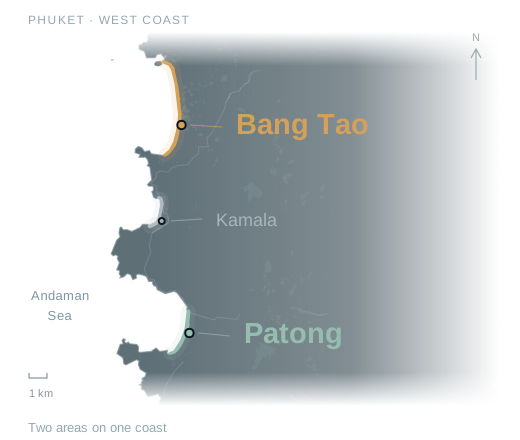
Bang Tao and Patong are both on Phuket’s west coast, but they are not neighbours: Surin and Kamala lie between them, about eleven kilometres apart in a straight line.
Both areas have grown into almost self-contained towns, but from different roots. Bang Tao was built around the Laguna resort on the site of a tin mine: golf, hotels, an international school and thousands of new apartments, with life here running on a car. Patong grew from a fishing village into the island’s main resort town: Bangla Road, a shopping mall, its own hospital, and everything within a kilometre of the sea. So Bang Tao means space and life by car, while Patong is a dense town where everything is close and noisy.
First, we look at where both areas came from: what was here before the tourists and how each one became what it is today. Without that, it is hard to see why they are so different.
Then we look at them as they are now: how they are laid out, what an ordinary day looks like for a resident, and where the areas are heading — what is being built and how that will change them over the next few years.
At the end come the conclusions: which area suits whom, what is known about rental returns, how to buy without overpaying, and whom to contact to check a specific property.
1. Bang Tao’s backstory
Forty years ago, the site of today’s Laguna Phuket resort complex was an abandoned tin mine. Tin was Phuket’s main source of wealth: it was smelted right here on the island and sold abroad.
By 1984 mining here had stopped, leaving behind a “moonscape” of sand and water-filled pits. A United Nations expert team assessing the island for tourism reportedly wrote this land off as too damaged to develop at all.
A year later the whole tin market collapsed. In October 1985 the international scheme that propped up tin prices went bankrupt, and prices fell by more than half. Mining stopped paying, and mines closed one after another: between 1983 and 1988 their number in Thailand fell from 735 to 171. By then Phuket was already gradually turning to tourism, and the tin crash only sped up that shift.
In 1984 the Singaporean entrepreneur Ho Kwon Ping bought this plot and decided to build a resort on 222 hectares of former mine — the future Laguna Phuket. His Banyan Tree hotel group grew out of this project.
The land was cleaned up over several years, more than 7,000 trees were planted, and the pits left by mining were turned into a chain of lagoons that gave the complex its name. The project later won an international environmental award for rehabilitating a toxic site.
The first hotel, Dusit Laguna, opened in 1987; two more hotels and a golf course followed in 1991–1992, and Banyan Tree’s own first resort opened in 1994. Today Laguna has six hotels, residential neighbourhoods and a golf course, all developed as a single estate under shared management.
Interestingly, Bang Tao also has its own original village — the Muslim settlement of Ban Bang Tao between Surin and Bang Tao beaches. People here used to fish; now many work in tourism.
On 26 December 2004 one of the strongest earthquakes in recorded history struck off the coast of Sumatra. It sent a wave crashing onto the shores of the Indian Ocean: about 230,000 people died in 14 countries, and in Thailand Khao Lak and Phuket’s beaches were hit hardest. Bang Tao was affected less than its neighbours: a month later, fewer than a fifth of the 1,854 hotel rooms along the six-kilometre beach were out of service.
Many link it to the fact that, after the tsunami, the whole world heard about Phuket: within a few years a property boom began on the island. In Bang Tao more and more people bought homes of their own: villas and residential complexes went up next to the hotels, followed by shops, restaurants and shopping centres. Between 2004 and 2024, land near Bang Tao Beach rose in price roughly tenfold — more than almost any other stretch of the island’s coast. That is how the resort gradually became an area where people not only holiday but live, and Bang Tao remains that way today.
2. Patong’s backstory
The name is made of two Thai words: “pa” means forest and “tong” is a banana leaf, which is used here to wrap food. Half a century ago, where the town now stands, there was a fishing village by the bay, surrounded by coconut palms and banana trees.
It was hard to get here. A dirt road over the hill to the coast was built only in the 1940s, and electricity arrived in 1979.
Tourists arrived before electricity did. The first were backpackers, who rented simple bungalows by the beach. In 1975 Tony Wheeler, the founder of the Lonely Planet guidebooks, described Patong as a long white beach with clear water.
In the late 1980s Patong became one of the island’s best-known beaches among Europeans, and the village quickly turned into a town. In 16 years its status changed three times: in 1986 it became a sanitary district, in 1994 a municipality, and in 2002 a town. Today about 21,000 residents are registered here.
The 2004 tsunami hit Patong harder than most beaches on the island. The wave rose to about 6 metres, and near the shore the water stood about 2 metres high. The walls of buildings by the sea held, but the seafront and ground floors were wrecked. The town recovered and kept growing.
In the 2000s the Jungceylon shopping mall opened behind the beach — one of the first big malls on the island. Before the pandemic it drew more than 17 million visitors a year, and in 2022–2023 it was rebuilt.
Nightlife has remained Patong’s defining feature. Since 15 December 2023, bars and clubs in six zones on Bangla Road have been officially allowed to stay open until 4 a.m.
3. Bang Tao on the map: what is where
Bang Tao is not a town or a village with a single centre, but a long strip along a bay on Phuket’s west coast. The easiest way to picture it is a rectangle of roughly 6 by 10 kilometres: the sea to the west, hills to the east, Surin Beach to the south and Layan Beach to the north. Officially this is the subdistrict of Choeng Thale, and Bang Tao is only the name of the beach, but listings use it for any part of the subdistrict.

The beach itself runs for about 6 kilometres — one of the longest on the island — and you can walk it from end to end. Moving inland from the sea, the area is laid out in bands:
By the water — hotels along almost the whole length of the beach.
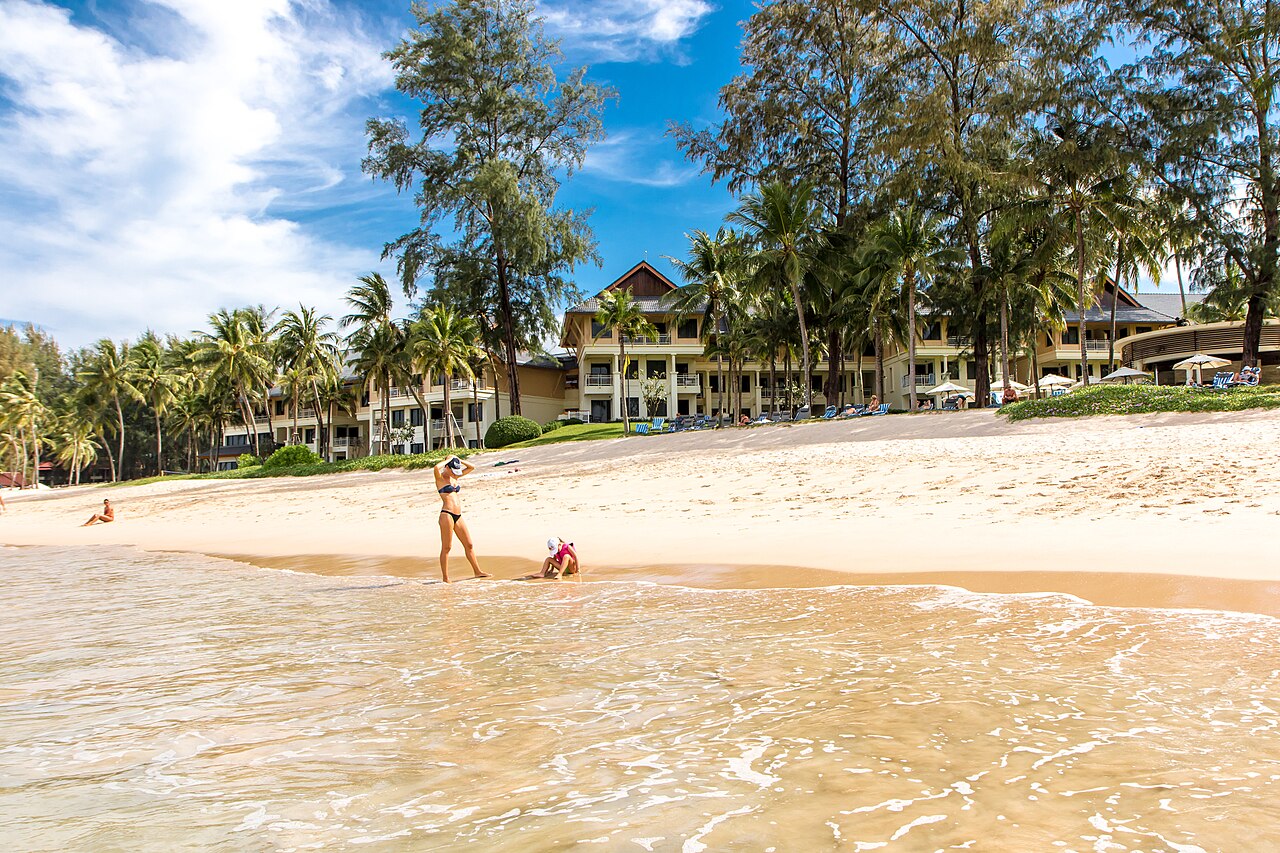
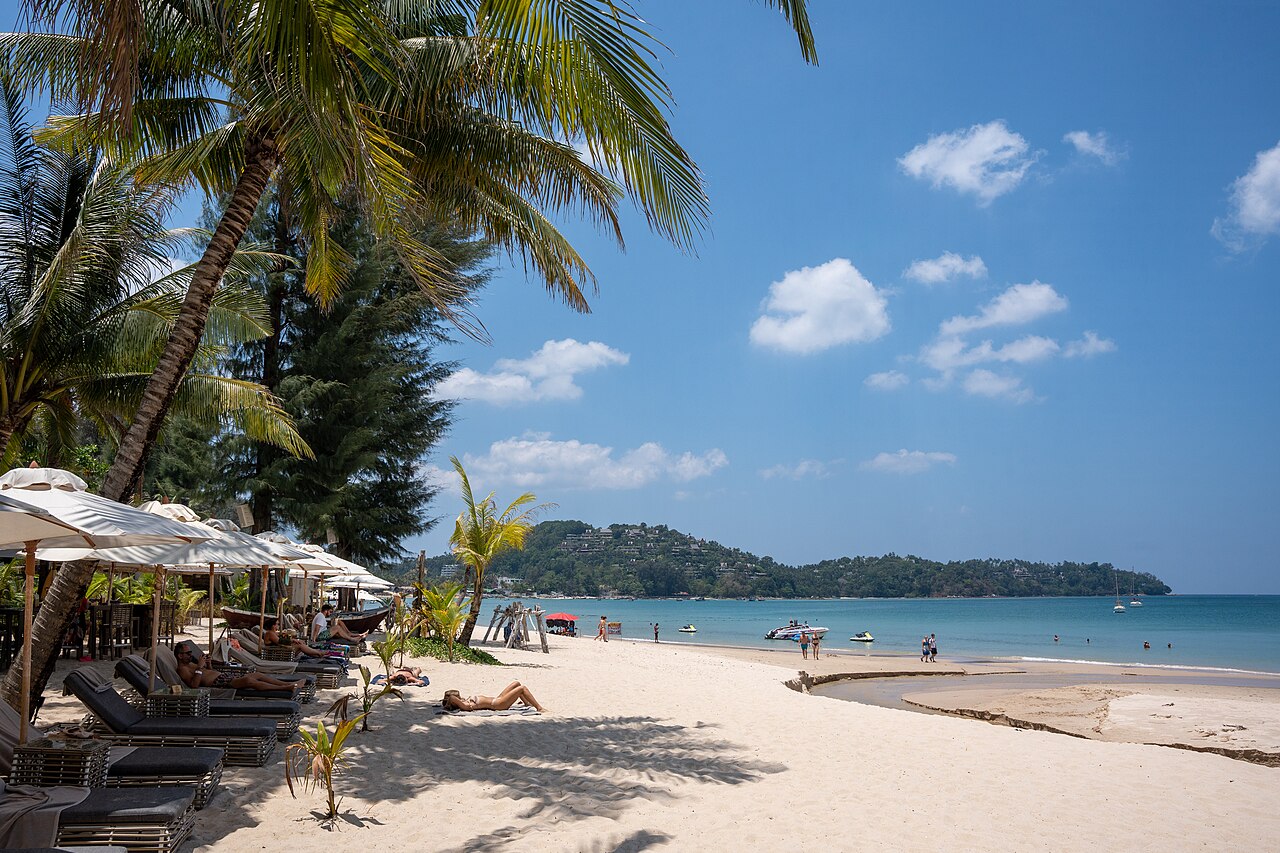
Behind the hotels, in the middle of the bay — Laguna: lagoons, a golf course and residential neighbourhoods with villas and apartments. The sea is 1–2 kilometres away from here.

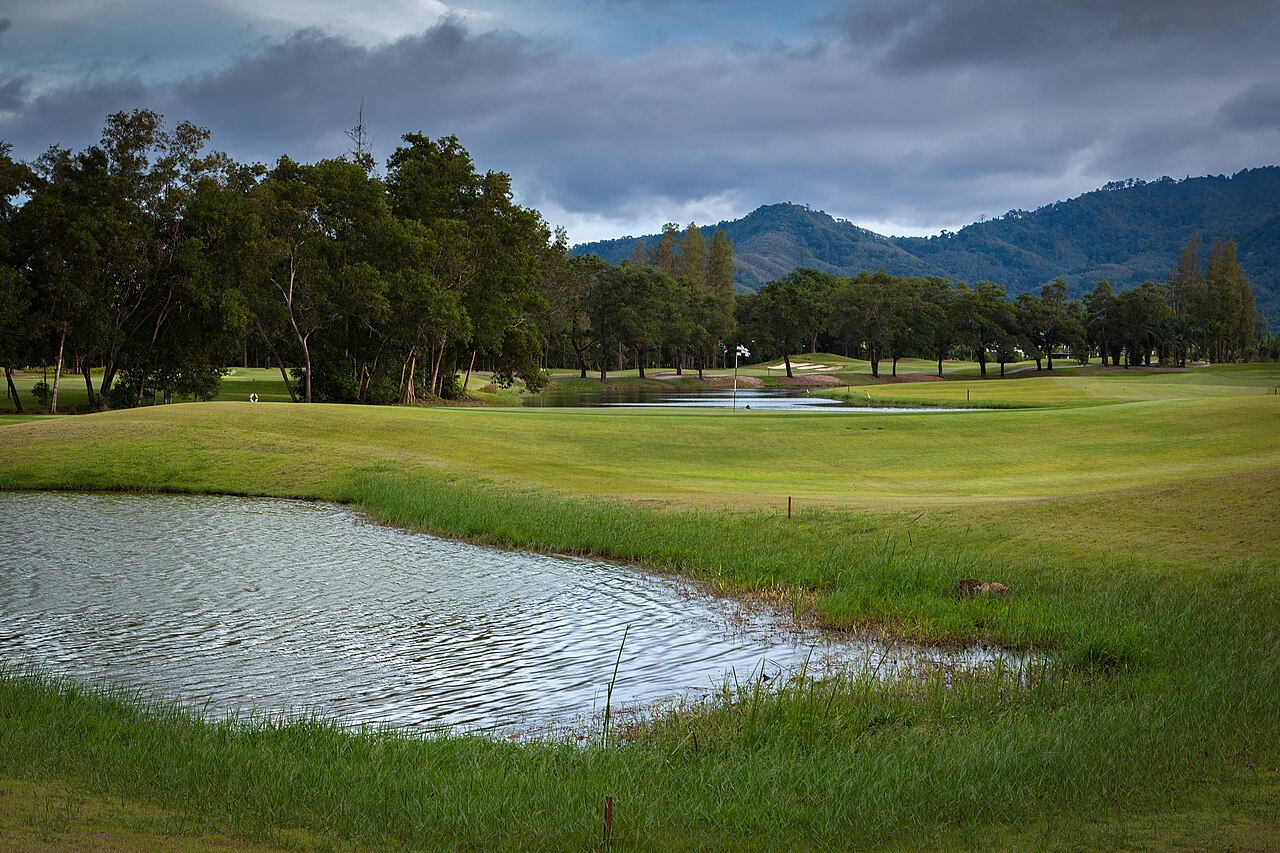
In the south, towards Surin — the village of Ban Bang Tao: narrow lanes, guesthouses, cafés and a night market.
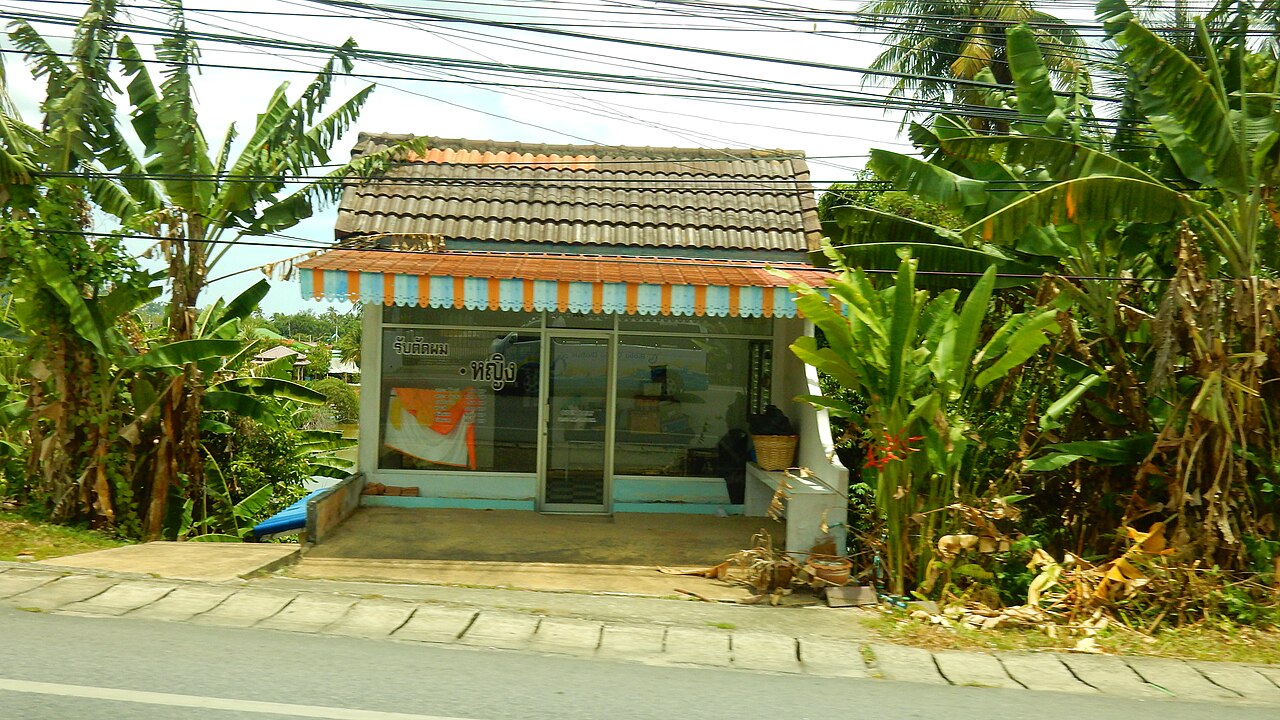
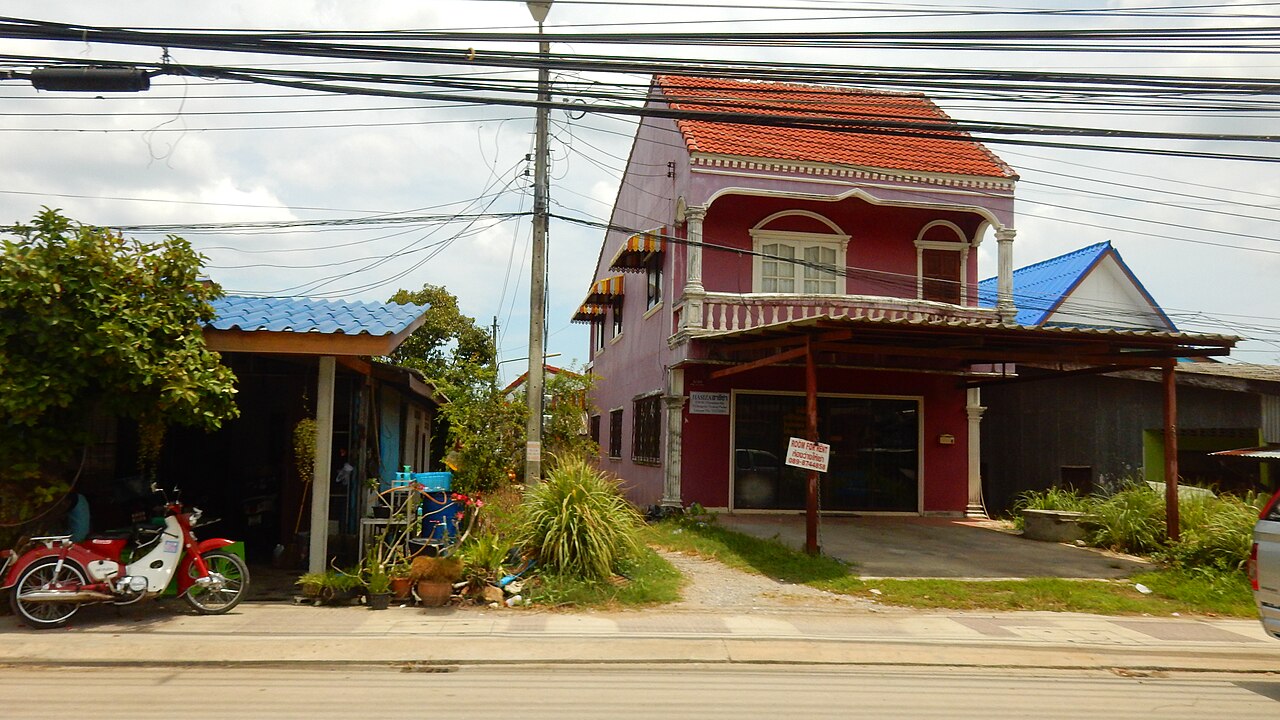
Along the main road, 1–2 kilometres from the sea — everything for daily life: Boat Avenue, a shopping street with restaurants and a supermarket at the entrance to Laguna; 800 metres from it, the Porto de Phuket shopping centre (opened in 2019); and nearby, a school, a fruit market and supermarkets.
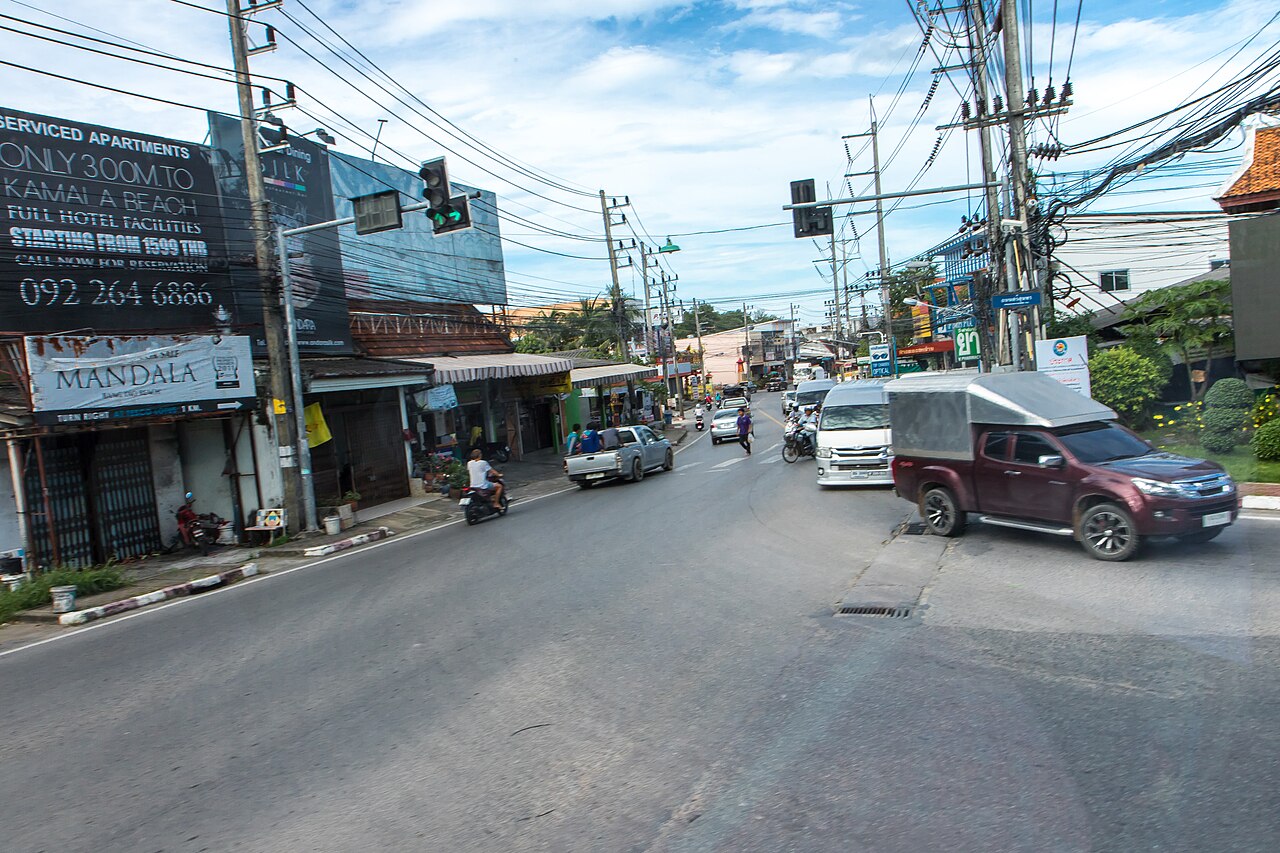
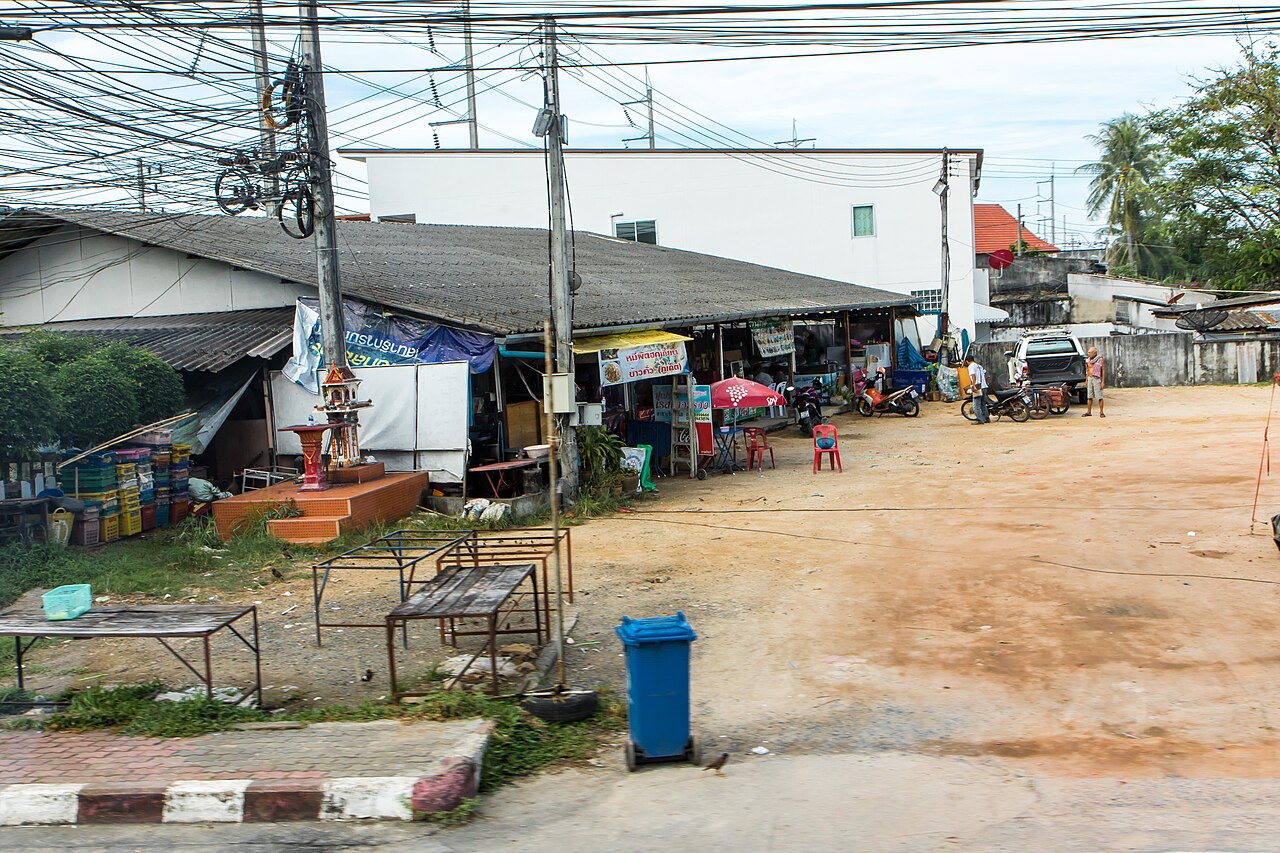
Further inland, by the hills — the Blue Tree water park and new residential projects, about 3 kilometres from the sea.
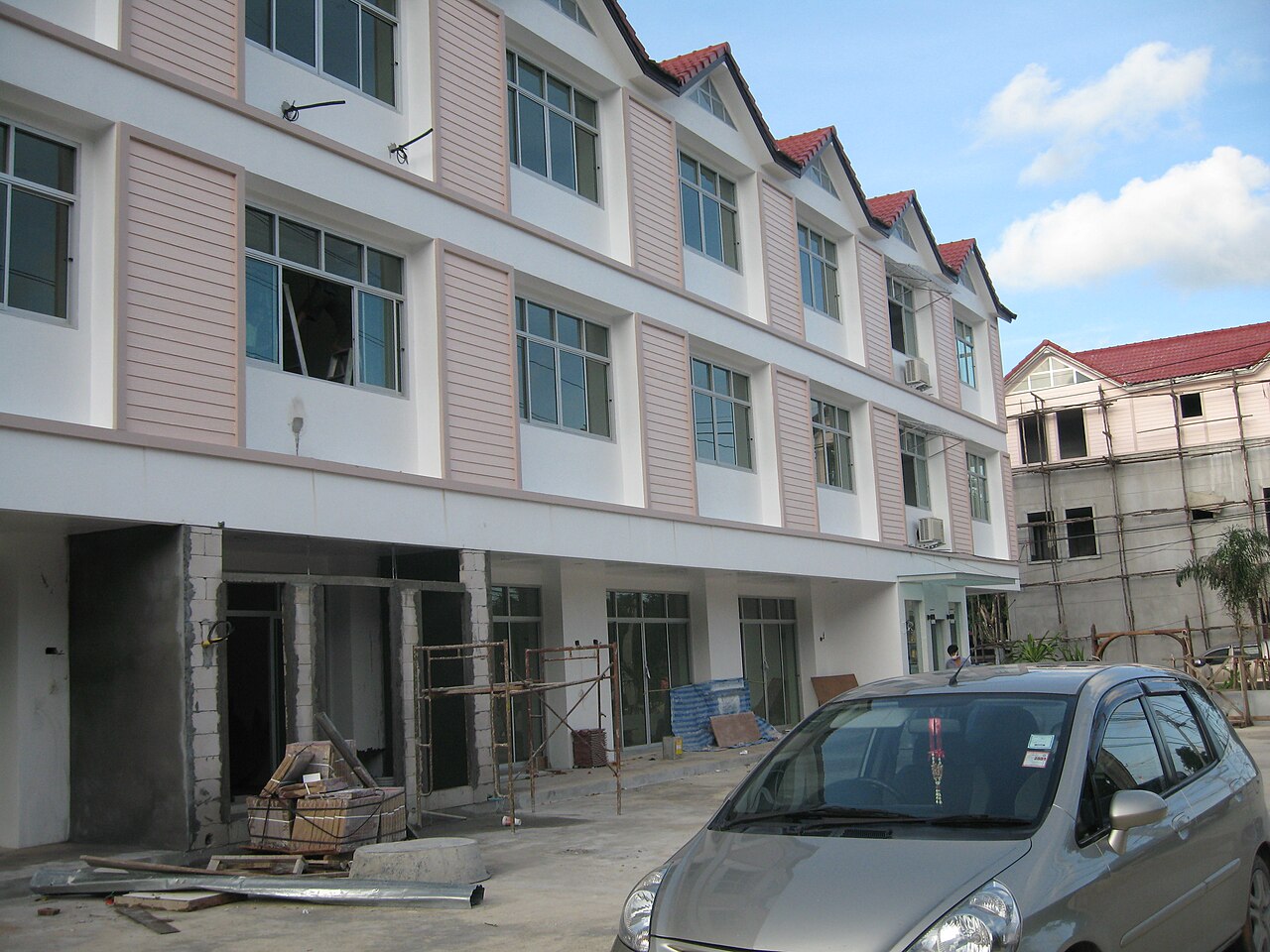
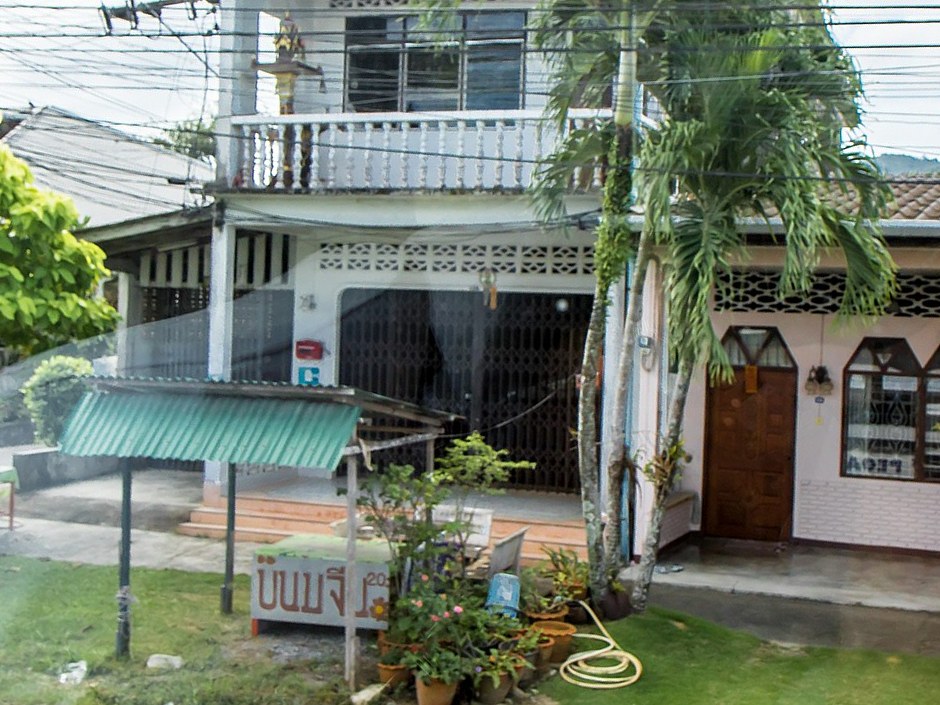
In the north — Layan, a separate, quiet beach 5 kilometres from the shopping centres.
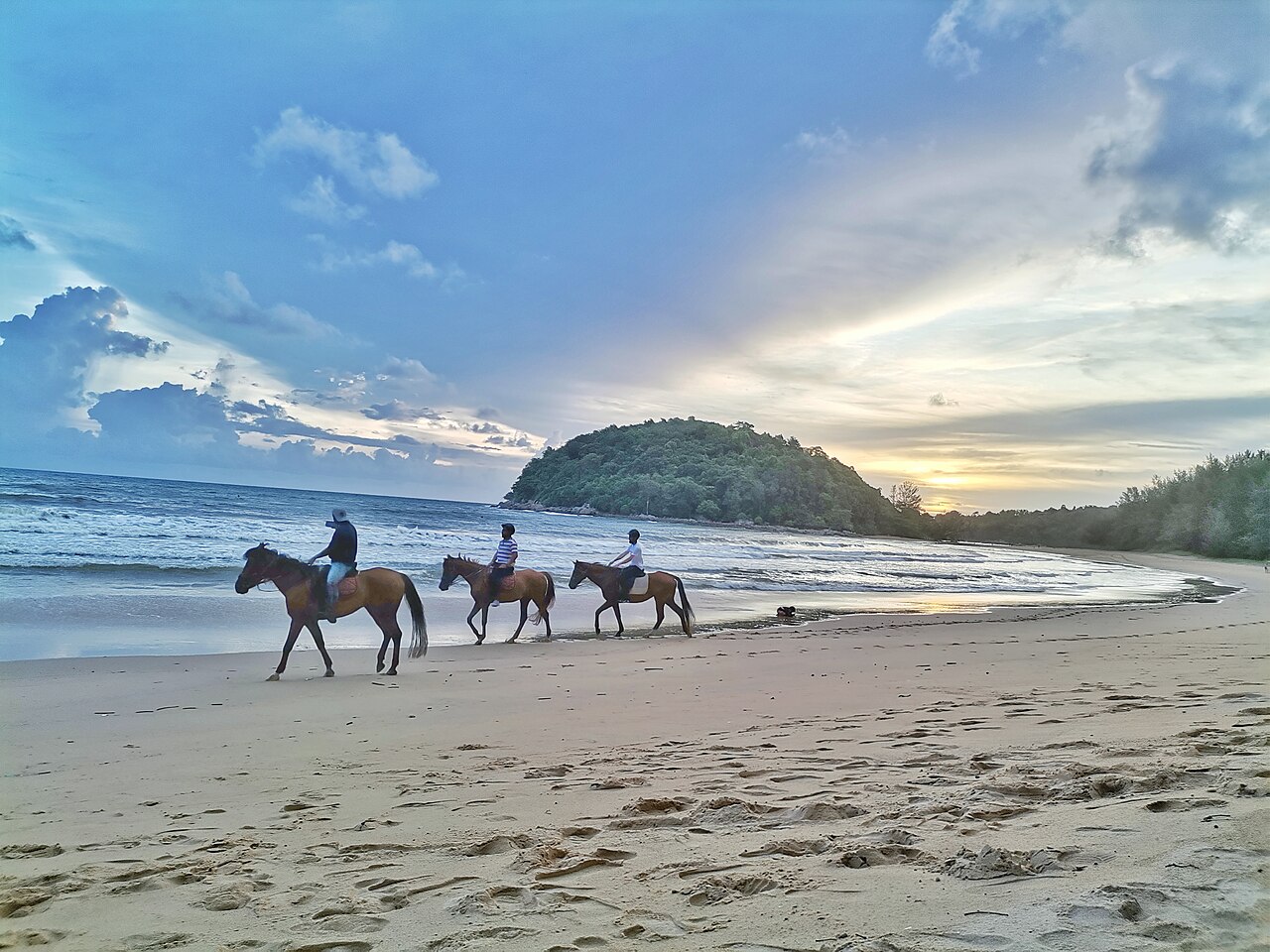
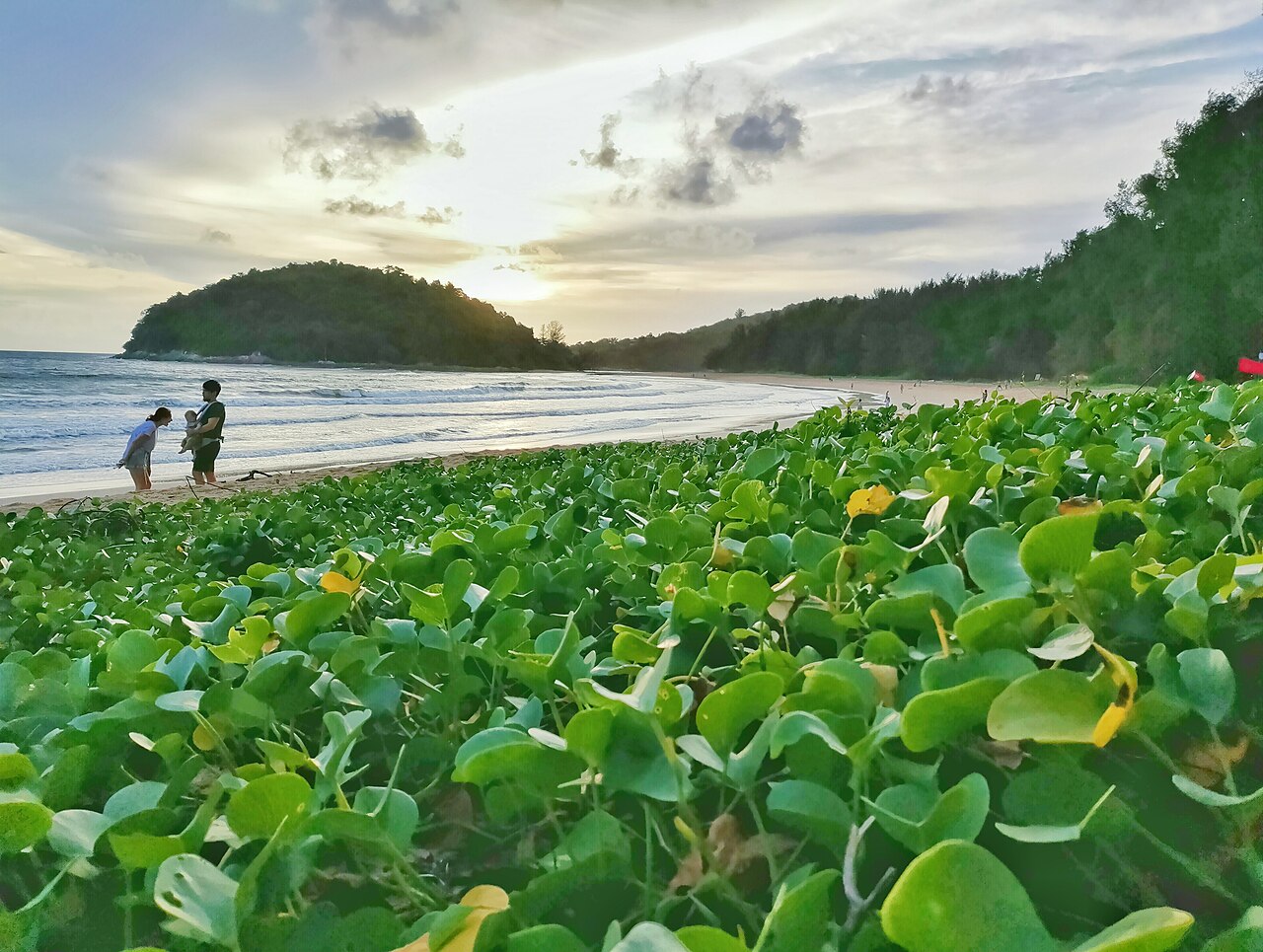
Everything that matters — the beach, Laguna and the shops — fits within 2–3 kilometres, but it is spread out, so people usually drive or ride a scooter between them and walk on the beach. There was plenty of free land here, so a lot is being built: Choeng Thale now accounts for almost half of all new apartments for sale on the island and a significant share of Phuket’s new hotels under construction.
Glossary
What the names in listings mean
| Name | What it actually is |
|---|---|
| Choeng Thale, Cherngtalay, Cherng Talay | The same place: the official subdistrict (tambon) that Bang Tao Beach belongs to. |
| Laguna | A private resort complex with lagoons in the north of the bay. Not a synonym for Bang Tao. |
| Layan | A separate beach by the northern headland. Listings sometimes count it as Bang Tao. |
| Pasak | A residential area inland. “Bang Tao” in a listing may mean this too. |
| Ban Bang Tao | A Muslim village in the south of the bay, towards Surin. |
4. Patong on the map: what is where
Patong is a large bay with a beach of about 2.9 kilometres, surrounded by hills on all sides. Officially it is a town of about 16 km² in Kathu district. Karon is about 5 kilometres south in a straight line, with the road running along the sea over a headland; Kamala is about 6 kilometres north, and Phuket Town, the island’s main town, about 10.

From the sea inland, the town is laid out like this:
By the water — Patong Beach and Thaweewong Road, the beach road that runs along it: hotels, cafés, massage, sunbed rental.
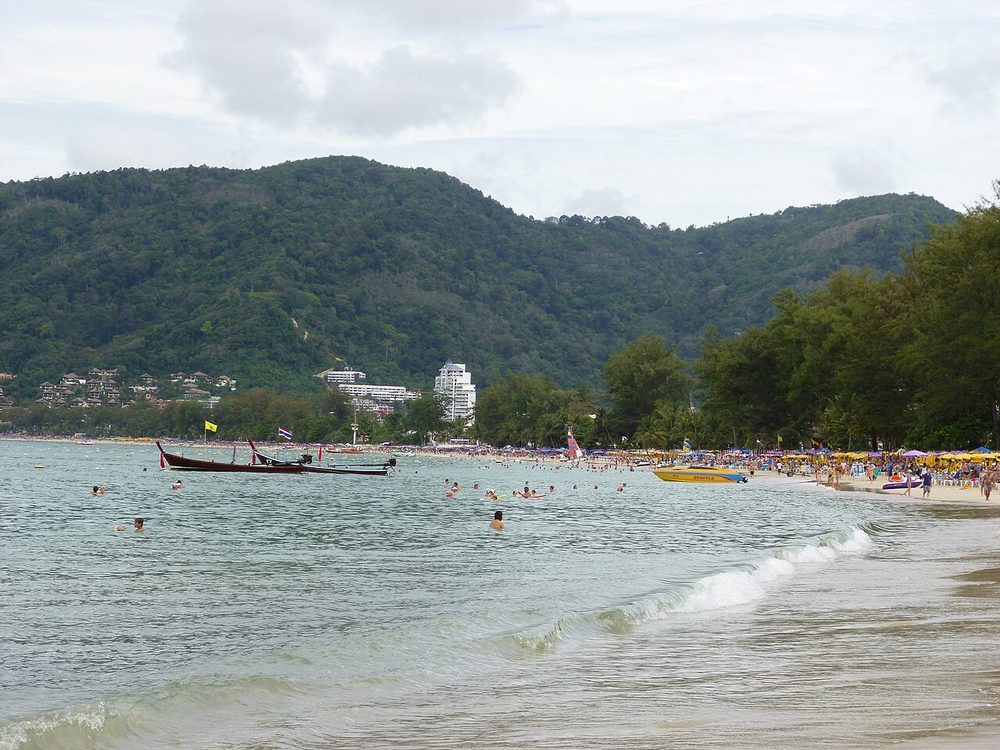
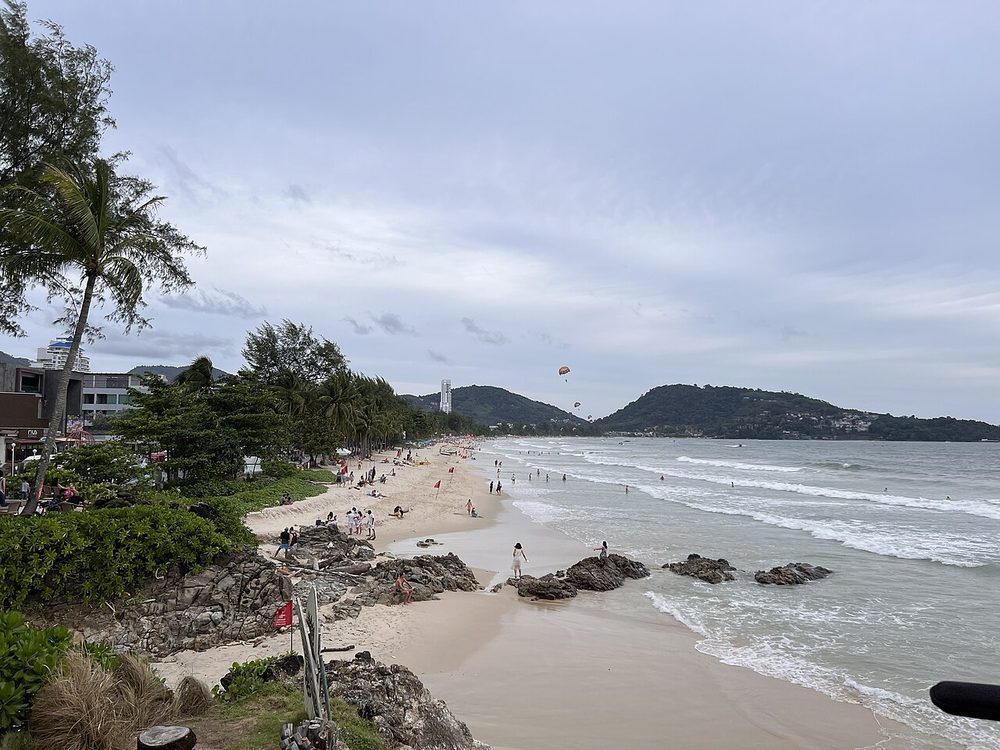
The centre — within a kilometre of the sea. From the beach, Bangla Road, the island’s main nightlife street, runs inland. A little further on are the Jungceylon mall with a Big C supermarket, Banzaan market and Patong Hospital.
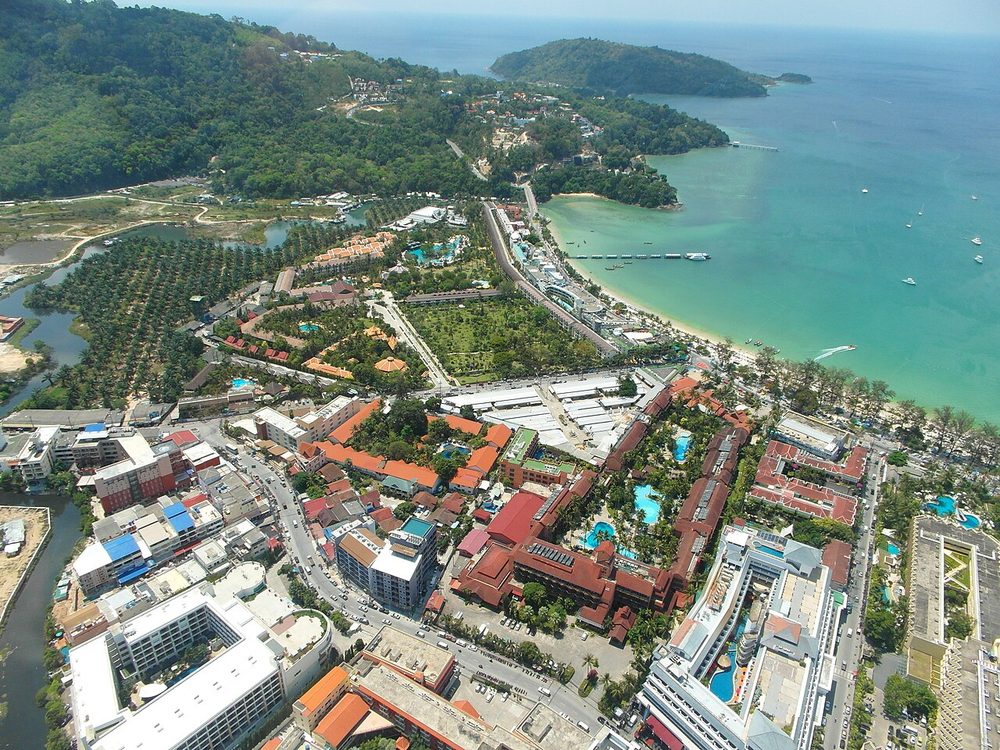
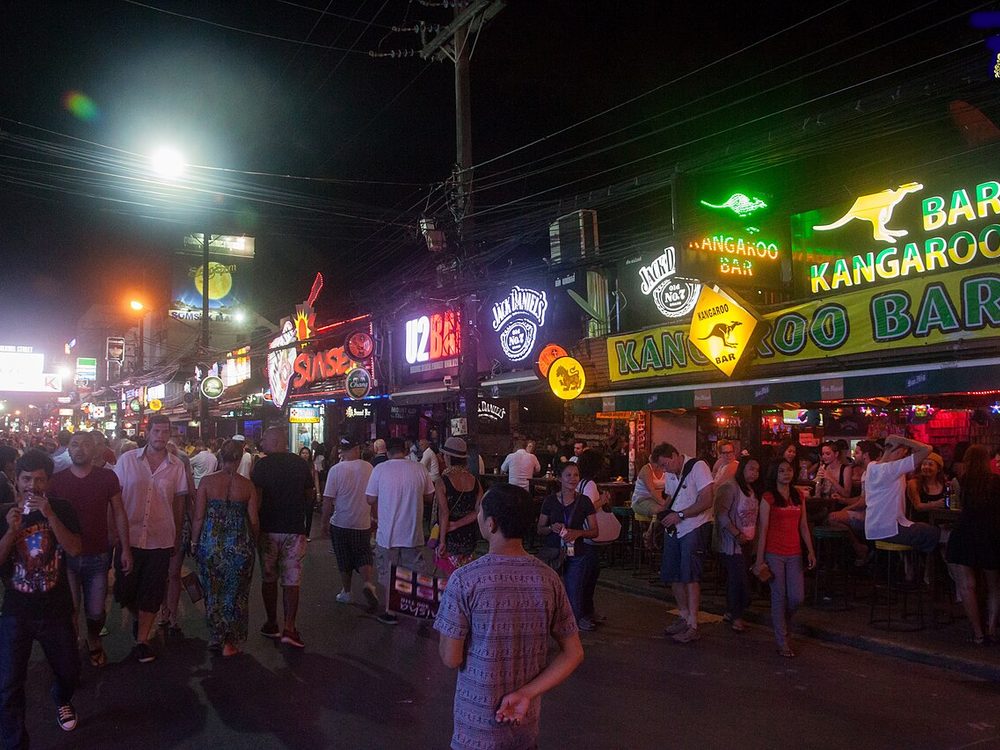
Further from the sea — Rat-U-Thit 200 Pee Road and the lanes behind it. There are fewer hotels and more homes and condominiums here, and about 1.5 kilometres from the beach stands the town’s main temple, Wat Patong.
The slopes — villas and condominiums with sea views on the hills around the bay. From here people go down to the centre and the beach by scooter or car.
At the edges — the small bay of Kalim to the north, with condominiums on the slope, and Tri Trang beach with its hotels beyond the headland to the south.
Patong’s centre is flat and easy to walk: from the beach to Jungceylon takes about 10 minutes. But the streets are narrow and, in high season, packed with cars and scooters. Only one road leads inland from the town — over the Patong Hill pass to Kathu and Phuket Town: a steep climb with hairpin bends.
Glossary
What the names in listings mean
| Name | What it actually is |
|---|---|
| Patong | The town and the beach. Patong is part of Kathu district, so listings often give the address as “Kathu”. |
| Kathu-Patong | Projects on the other side of the pass, in Kathu itself, often carry this name. From there it is about 30 minutes to the beach on the mountain road. |
| Kalim | A small bay on Patong’s northern edge. Quieter than the centre, with condominiums on the slope. |
| Bangla Road | The nightlife street in the centre. An apartment next to it means music until morning. |
5. A day in Bang Tao and in Patong
Let’s walk through an ordinary day in both areas — from the walk to the sea in the morning to the quiet at night.
Morning: getting to the sea
Bang Tao. If you live right by the beach or in a hotel, you walk to the sea. From Laguna’s residential neighbourhoods the water is already 1–2 kilometres away, and from the new projects by the hills about three, so the day usually starts with a car or scooter. People mostly swim in the southern part of the bay: in the north there is a coral reef close to shore.
Patong. From the centre to the beach is a 5–10 minute walk. The beach is wide and long: quiet in the morning, crowded by lunchtime, with jet skis and parasailing behind boats along the water. From the slopes people go down by scooter or car.
Children: kindergarten and school
Bang Tao. HeadStart International School has a campus in Choeng Thale, about 4 kilometres from the beach, taking children from preschool up to Year 9 (age 13–14). A year costs from 347,000 to 540,000 baht depending on age; the school bus is extra.
Patong. The town itself has municipal kindergartens and a Thai municipal school. There are no international schools in Patong. The nearest are in Kathu and Phuket Town, reached by a single mountain road over the Patong Hill pass, about 30 minutes to Kathu.
Errands: shops, market, doctor
Bang Tao. Everything for daily life is along the main road, 1–2 kilometres from the sea: Boat Avenue with restaurants and a supermarket, the Porto de Phuket shopping centre, a fruit market, Villa Market. The clinic in Laguna is open every day from 9:00 to 18:00. From most homes people drive here rather than walk.
Patong. Everything for daily life is within a kilometre of the sea: the Jungceylon mall with a Big C supermarket, Banzaan market, mini-marts on almost every street and private clinics. The town has its own public hospital, which mainly handles emergencies. The large private hospitals are in Phuket Town, over the same pass.
Getting around the island
Bang Tao. The Phuket Smart Bus runs from the airport through Choeng Thale to the south, and a ticket costs 100 baht. But it stops only on the main roads and does not reach the residential complexes inland — without your own transport, life here is hard.
Patong. The Phuket Smart Bus from the airport runs along the coast and passes through Patong; a ticket costs 100 baht. To Kathu and Phuket Town people drive over the Patong Hill pass: the road is steep with hairpin bends, about 30 minutes to Kathu. A tunnel under the pass is planned for 2031, but the project is still going through approval.
Evening
Bang Tao. In the evening people drive to dinner on Boat Avenue or at Porto de Phuket, or go to the beach venues by the sea. The sun sets right over the bay.
Patong. In the evening the town comes alive more than in the daytime: Bangla Road, bars, clubs, shows, night markets and restaurants along the beach. On Bangla, bars are officially open until 4 a.m.
Night and quiet
Bang Tao. Quiet here depends on the street. The main source of noise is construction: almost half of all new apartments on the island are currently for sale in Choeng Thale, and another one may well be going up next to your home.
Patong. In the centre and around Bangla, loud music plays until morning. It is quieter in the lanes further from the sea, on the slopes and in Kalim bay. During the day and in the evening the streets are packed with cars and scooters.
And in the rainy season
Bang Tao. From May to October there are downpours, waves at sea and red flags on the beaches. In heavy rain the roads near Boat Avenue and at the Ban Don junctions flood, causing traffic jams.
Patong. The town sits in a bowl between hills, and in downpours water runs off them into the streets. In October 2026, after prolonged rain, the floods carried rocks and mud into residential areas and shopping streets, damaging homes, shops and cars. From May to October there are strong currents and red flags on the beach.
In short
A day: comparison
| Bang Tao | Patong | |
|---|---|---|
| To the sea | On foot only from the beachfront and hotels; 1–2 km from Laguna, about 3 km from the hills | 5–10 minutes’ walk from the centre; from the slopes — by transport |
| Children | HeadStart International School up to age 13–14, 347,000–540,000 baht a year | Thai municipal kindergartens and school; international ones in Kathu and town, over the pass |
| Shops and doctor | Along the main road, 1–2 km from the sea; usually by car | Jungceylon, Big C, Banzaan market and the hospital — within a kilometre |
| Transport | Bus only along the main roads; hard without a car or scooter | Coastal bus; to Kathu and town over the pass, about 30 minutes |
| Evening | Restaurants at Boat Avenue and Porto de Phuket, beach venues | Bangla, bars and clubs until 4 a.m., restaurants by the beach |
| Noise | Mainly construction | Music until morning in the centre; heavy traffic |
| Rainy season | Flooding near Boat Avenue and Ban Don, waves | Water and mud from the hills, flooded streets, currents |
6. Where the areas are heading
Once you know where both areas came from, it becomes clear how they are growing now. Bang Tao is being built up in whole neighbourhoods, while Patong is almost fully built up and is waiting for a tunnel to Kathu.
Bang Tao is growing outwards
Bang Tao grew around Laguna, which a large developer built on the site of a mine, and it is still growing the same way — through big projects, only on a different scale. According to C9 Hotelworks analysts, as of November 2025 the wider Choeng Thale area had 21,625 new apartments and houses for sale — 48% of all new housing in Phuket. A significant share of the island’s hotels under construction is coming here too: Phuket has 41 hotels with more than 8,000 rooms in the pipeline, and analysts name Bang Tao and Choeng Thale as one of the main places where they are concentrated. The Banyan group, with which Laguna began, keeps releasing new phases: in 2026, a new Bellaguna building and eight Varuna villas.
In effect, the resort is turning into a self-contained small town with everything in it: homes, hotels, shops, a school. For a buyer this has two sides. The choice is huge and the area keeps developing. But there will be construction next to your home for years, and you will be renting out and later selling among thousands of similar apartments.
Patong is waiting for a tunnel
The biggest change for Patong is a tunnel under the Patong Hill pass to Kathu. Under the schedule the government announced in September 2026, the project goes to the Cabinet for approval in December 2026, construction starts in October 2027, and the tunnel is planned to open in October 2031. The drive from Kathu to Patong would take about 5 minutes instead of 30. The dates have already slipped more than once, so do not count on the tunnel when buying.
New homes are going up inland and on the slopes. The most visible project is BRISA Patong by Sansiri, one of Thailand’s largest developers: three eight-storey buildings with 389 apartments right behind Jungceylon, about 900 metres from the beach. About 70% of the apartments are one-bedrooms of 30–34 m². Booking opens on 25 November 2026, with prices from 3.9 million baht.
For a buyer this means more small apartments designed for renting out in the centre. The choice gets wider, but there will also be more competitors for tourist guests.
7. What is for sale here
In both areas, essentially two things are sold: apartments and villas. The difference between them is not just size, but what exactly you end up owning.
Apartment
Apartments are sold in residential complexes — in Thailand such a building is called a condominium. A complex usually has a shared pool, gym and security, and a management company keeps things in order.
A foreigner can register an apartment in their own name outright and permanently — this is called freehold. There are usually two main conditions. First, foreigners may own no more than 49% of the total floor area of all units in a building, so before buying you check whether the foreign quota is still available. Second, the money for the purchase comes from abroad, and the bank issues a certificate confirming this. There are other legal routes — for example, Thai permanent residence — but most buyers go this way.
Villa
A villa is a detached house with its own plot, usually with a private pool. This is more complicated: as a rule, a foreigner cannot buy land in Thailand in their own name. So the land is most often taken on a long-term lease, usually 30 years — this is called leasehold — and the house itself is registered separately. The law does not guarantee renewal of the lease after 30 years; it is written into the contract.
In short: a foreigner usually buys an apartment freehold, sometimes on a long lease; a villa comes as a freehold house plus a long land lease. That is neither better nor worse, but a villa’s documents need closer checking.
What is sold where
In Bang Tao apartments are mostly built in new complexes along the main road and closer to the hills, while Laguna itself sells both apartments and villas. Villas are found across the subdistrict. In Patong mostly apartments are sold: in older and newer complexes in the centre and further inland, and with views on the slopes and in Kalim bay. Some apartments in Patong are sold as leasehold, a long-term lease rather than ownership — for example, with a lease running to 2045. This is checked before buying.
Prices
Below are real listings: for Bang Tao as of October–November, for Patong as of November 2026. These are sellers’ asking prices, not transaction prices, and the sample is small, so look at the order of magnitude rather than exact amounts.
Prices
Sample listings for sale
| Bang Tao | Patong | |
|---|---|---|
| One-bedroom apartment | 4.75–10.5 million baht for 35–57 m²: from 131,000 to 214,000 baht per m² | 1.8–8.9 million baht for 34–81 m² (the cheapest is leasehold): from 45,000 to 124,000 baht per m² |
| Larger apartment | 2 bedrooms, 62–99 m² — 7.2–18.5 million baht (116,000–187,000 baht per m²) | 2 bedrooms, 64–162 m² — 7–18 million baht (74,000–133,000 baht per m²) |
| Villa | 3 bedrooms, 285–412 m² — 27.7–29.2 million baht | 3 bedrooms, 180–368 m² — 12.9–55 million baht |
Price depends heavily on how new the building is, the view and how far it is to the sea. So compare properties of the same type and with the same form of ownership.
8. Money: costs, renting, living and resale
Buy to rent, live here yourself or do both. First, let’s look at what you will pay either way.
What you will pay
An apartment comes with a mandatory monthly fee for the upkeep of the complex: the pool, cleaning, security. For example, in the new The Title complexes in Bang Tao it is 75 baht per m² a month — about 4,000 baht for a 50 m² apartment. At The Emerald Terrace in Patong it is 50 baht per m², about 2,500 baht for the same apartment. When you receive the keys to a new build, you also make a one-off payment into the building’s sinking fund. A villa may also have shared charges, plus the upkeep of the pool and garden and repairs.
Long-term rental
A one-year contract: the tenant pays monthly and covers electricity and water. Income is lower, but it is calmer: you do not have to find new guests every few days.
For example, listings from autumn 2026. In Bang Tao: a 35 m² one-bedroom — 35,000 baht a month, a 300 m² three-bedroom villa — 85,000 baht. In Patong: a 30 m² apartment — 19,800 baht a month, a 48 m² one-bedroom at The Emerald Terrace — 28,000 baht; most one-bedroom apartments rent for 20,000–40,000 baht. The rate depends heavily on the complex and the season, so the real price is best judged from 5–10 similar listings in your chosen spot.
Short-term rental
Guests come for a few days, as they would to a hotel. They pay more per night, but the property often stands empty, especially in the rainy season. According to AirROI, a service that collects Airbnb data, over the past year homes in Choeng Thale, which includes Bang Tao, were booked for about 40% of the nights open for booking, and in Patong for about 38%. Thousands of new apartments are on sale in Bang Tao, and Patong has about 1,500 active Airbnb listings.
Something else matters too: under Thai law, renting an apartment out by the night counts as running a hotel, and it is not allowed everywhere without a licence. On top of that, every complex has its own rules — some ban short-term rentals. This is checked before buying.
If you rent through a management company rather than yourself, it takes a share of the income: usually 20–30% for short-term rentals and 10–20% for annual leases. The booking platform takes its own commission too: on Airbnb it can reach 15.5%. So the owner receives noticeably less of the nightly rate than the listings suggest — before buying, ask the management company for a net-income calculation.
Live here yourself
In Bang Tao life runs on a car or scooter, but HeadStart school, the Boat Avenue restaurants and a shopping centre are close. In Patong the mall, the market and the hospital are within a kilometre of the sea and much can be done on foot, but the centre is noisy until morning, and international schools are about 30 minutes away over the pass.
Beyond the complex fee, the main cost is electricity, mostly air-conditioning. And while you are away, someone has to look after the apartment: in the rainy season it needs airing and checking for leaks. A management company usually takes care of this.
Live here part of the year and rent it out
What matters is which months you come. Homes rent best from November to April; in the rainy season, from May to October, there are fewer guests. If you live here in winter, you will be renting out in the weak months, and income will be well below the annual figure. If you come in summer and rent out in winter, it works out better.
While you are away, you can let the apartment for a few months at a time or by the night. For nightly rentals, check the licence and the complex’s rules in advance; check-ins are usually handed to a management company.
Resale
In Bang Tao you will be selling among thousands of new apartments from developers. In Patong, alongside hundreds of similar small apartments and new complexes such as BRISA.
9. Which to choose for your goal
Choice
Where you win with different goals
| Goal | Leans towards | Why |
|---|---|---|
| Living with school-age children | Bang Tao | HeadStart International School, up to age 13–14, right in the subdistrict. From Patong, international schools are about 30 minutes away over the pass. |
| Living with young children (under 7) | Bang Tao, more likely | Spacious, with HeadStart’s preschool groups nearby and calmer evenings. Patong has a hospital close by, but also noise and heavy traffic. |
| Living as a couple or alone, without children | Depends on your lifestyle | Bang Tao — if you want space, golf and the Boat Avenue restaurants. Patong — if you want a town and nightlife within walking distance. |
| Living without a car | Patong | A mall, market, hospital and the beach within a kilometre. In Bang Tao it is hard without a car or scooter. |
| Living with a car or scooter | Bang Tao | The airport and the north of the island are closer, and in most of Bang Tao a car or scooter is more convenient anyway. In high season Patong’s streets are packed, and only one road leads inland — over the pass. |
| Wintering for a few months | Depends on taste | Bang Tao — a resort town with a beach, golf and restaurants. Patong — town life, where everything is close and open late. |
| Nightlife | Patong | Bars and clubs on Bangla are officially open until 4 a.m. People from Bang Tao come to Patong for it. |
| Quiet | Bang Tao | The main noise here is construction. In central Patong music plays until morning. |
| Long-term rental | No clear winner | Rates depend on the complex. A family with a school-age child will look in Bang Tao, near the school, and someone who wants everything on foot — in Patong. |
| Short-term rental | No clear winner | According to AirROI, occupancy is close: about 40% of nights in Choeng Thale and 38% in Patong. It depends on the property. |
| Buying a villa | Bang Tao | Villas are sold across the subdistrict and in Laguna. In Patong mostly apartments are sold, with villas only on the hills around the bay. |
| Smallest budget | Patong | In our selection, a one-bedroom in Patong starts at 1.8 million baht for 40 m², and it is leasehold. In Bang Tao — from 4.75 million baht. |
10. How a purchase works and what to check
Buying in Thailand is simpler than it seems, but several parties are involved: the agent, the lawyer, the bank and the land office. Here is how it usually goes, step by step.
1. Search: developer or agent
A new apartment is bought from the developer — directly or through an agent. In that case the developer usually pays the agent’s commission, but it is still worth comparing the price and promotions with the developer’s direct offer before reserving. A resale home from a private owner is almost always sold through an agency. Here too the seller usually pays the commission, most often 3–5% of the price, but terms vary, so ask about it straight away.
2. Viewing
Many people first view properties by video, but it is better to see the chosen home yourself or send someone you trust: the walk to the sea, noise and nearby construction do not show up on video. What exactly to check on site is in the list below.
3. Your own lawyer
This is the key step, and it starts before any money changes hands. You hire the lawyer yourself; they must not work for the seller or the agent. First they read the reservation terms: who receives the money and when it is refunded. Then, at the land office, they check the title deed, debts and encumbrances, the building permit and whether the building still has foreign quota available, and they read the contract. For a villa, they also check the land lease: its term, the renewal conditions and what happens to the house.
4. Reservation
Once the lawyer has seen the terms, you pay a small reservation deposit — the seller takes the property off the market while the full check is done. The amount and the refund terms are set out in the reservation agreement.
5. Contract and payment
Next, the sale and purchase agreement is signed. A new build is usually paid for in instalments as construction progresses; a finished home with a deposit at signing and the balance at registration. The money is transferred from abroad to a Thai account, stating property purchase as the purpose of payment. The bank issues a transfer certificate — if the apartment is registered on this basis, it cannot be done without it.
6. Registration
The provincial land office registers either the ownership or the long-term lease. You do not have to attend in person: a lawyer can do it under a power of attorney. Fees are paid here too: 2% of the appraised value for the transfer (the contract decides who pays, often split in half). Most often the seller also pays income tax and 0.5% stamp duty, or, if selling within five years of buying, a 3.3% specific business tax instead of stamp duty. If you are leasing land for a villa, the lease agreement is registered, with a fee of about 1% of the total rent for the whole term. There are exceptions, so it is best to work out the amount for your deal with a lawyer in advance.
7. Keys
After registration, the handover certificate is signed, you receive the keys and start paying the complex’s maintenance fees. If you plan to rent the property out, this is also when you choose a management company.
In short: the agent searches, the lawyer checks, the bank confirms the transfer, and the land office registers. Buying a finished home usually takes a few weeks; with a new build, you wait until construction is complete.
Checklist
Before paying a deposit
- The exact address and the route to the sea — on foot, not on a map.
- The plot in the rain: drainage and elevation — in Bang Tao’s low-lying areas near Boat Avenue and Ban Don and in Patong’s low-lying streets; on the slopes, retaining walls as well.
- For a hillside: is there construction or a steep cut further up the hill?
- Noise at different times of day: construction in Bang Tao; bars and clubs around Bangla and heavy traffic in Patong.
- Whether short-term rental is allowed in this particular building.
- Title to the land and the building, foreign quota, payment history.
How to choose
Three steps
- 01
Define your goal
Living there yourself, renting out, or both: this decides which area wins.
- 02
Check the address
Not the area name, but the point on the map: the route to the beach, the terrain, nearby construction.
- 03
Ask for the numbers
A year of rental and cost reports for the specific property, not area averages.
11. Risks and how we can help
You can choose an area yourself: everything discussed above can be checked on a map, in listings and in conversation with the seller. It gets harder with a specific property and its documents. These are the problems buyers in Phuket run into most often:
- Land “held through a Thai company”. So that a foreigner can own the land under a villa, sellers sometimes offer to register it to a Thai company whose Thai co-owners exist only on paper. The law prohibits this, and such property can be lost.
- Land with an incomplete title. Land documents in Thailand come in different kinds, and not all of them give full ownership. On the hills there are plots where building should never have been allowed at all.
- An apartment beyond the quota. If a building’s foreign quota is already used up, the apartment cannot be registered to you as freehold — you may be offered a lease instead, without always being told so plainly.
- A deposit paid to the wrong person. Money is transferred only under a signed contract and only to an account whose owner your lawyer has verified.
- Promised returns. A “guaranteed income” from a developer is a promise by one particular company, not by the market. If the company runs into trouble, the payments stop.
- Construction delays. A new build is paid for in instalments, and if the developer misses deadlines, your money is tied up. That is why people look at how the developer delivered its previous projects.
- Short-term rental without a licence. Renting an apartment by the night where it is not allowed can bring fines, and the complex may ban the rentals.
Almost all of this is solved by one thing: checking before you pay. That is why the key step in buying is having your own lawyer.
At the same time, Phuket is one of the liveliest resort property markets in Asia: people come here on holiday and move here to live, and developers are bringing thousands of new apartments to market. There are many opportunities here, but also many nuances that are easy to get lost in from the outside.
Need help choosing an area in Phuket?
Leave your email and get a free consultation.
12. Frequently asked questions
Which area is better for renting out?
According to AirROI, occupancy is close: about 40% of nights in Choeng Thale, which includes Bang Tao, and about 38% in Patong. It depends on the specific property and its reports.
Can you live here with school-age children?
Yes, and it is easier in Bang Tao: HeadStart International School takes children up to age 13–14. Patong has Thai municipal schools, and international schools are about 30 minutes away on the mountain road over the pass.
Does “Bang Tao” in a listing mean by the sea?
Not necessarily — it may be the inland part of Choeng Thale subdistrict. Check the point on the map.
Is it noisy to live in Patong?
In the centre and around Bangla Road, yes — bars are open until 4 a.m. It is quieter in the lanes further from the sea, on the slopes and in Kalim bay. Come and see the apartment in the evening and at night, not just in the daytime.
Does “Kathu” in a listing mean Patong?
Not always. Patong is part of Kathu district, so apartments in Patong often have “Kathu” in the address. But projects named “Kathu-Patong” are often on the other side of the pass, in Kathu itself — about 30 minutes from the beach. Check the point on the map.
Does Patong flood?
In heavy downpours, yes: the town sits in a bowl between hills, and water runs off them onto the low-lying streets. Check the floor, the elevation of the plot, and ask the neighbours and the management company what happened in October 2026.
Can a foreigner buy a villa?
The house itself — yes; the land under it — no. The land is usually leased for 30 years and the house is registered separately. Lease renewal is written into the contract; the law does not guarantee it.
What are freehold and leasehold?
Freehold is full ownership in perpetuity — this is how apartments are registered. Leasehold is a long-term lease, usually for 30 years — this is how the land under a villa is most often held.
Can you buy an apartment without coming to Thailand?
Yes. A lawyer can carry out the registration at the land office under a power of attorney. But it is better to see the property in person or through someone you trust.
Who pays the agent’s commission?
Usually the seller: for new builds the developer, on the resale market the owner, most often 3–5% of the price. Confirm the terms before reserving.
How much does a one-bedroom apartment cost?
According to listings — from 4.75 to 10.5 million baht in Bang Tao (October–November 2026) and from 1.8 to 8.9 million baht in Patong (November 2026, the cheapest is leasehold). These are sellers’ asking prices, not transaction prices.
Can you rent an apartment out by the night?
Not everywhere. Under Thai law, renting by the night counts as running a hotel, and many complexes prohibit it in their own rules. Check before buying.
When is the rainy season in Phuket?
Roughly from May to October. At this time there is more rain and more waves, red flags go up on the beaches, roads in low-lying areas flood, and landslides happen on the hillsides.
Sources
- Phuket Insider — Patong: a fishing village, a road in the 1940s, electricity in 1979.
- The Thaiger — Patong in Tony Wheeler’s 1975 guidebook.
- Wikipedia — Patong: beach length, popularity in the late 1980s, the tsunami.
- Wikipedia (Thai) — Patong municipality: status in 1986, 1994 and 2002, population, area.
- Proceedings of Civil Engineering in the Ocean — tsunami height on Patong Beach.
- CDL — Jungceylon: visitor numbers and the 2022–2023 renovation.
- Bangkok Post, 07.12.2023 — Bangla Road bars until 4 a.m..
- Patong Town Municipality — municipal school and kindergartens.
- Nation Thailand, 16.09.2026 — Kathu–Patong tunnel: schedule and travel time.
- Malay Mail, 26.10.2026 — floods and mudflows in Patong.
- Thailand-Property — BRISA Patong by Sansiri.
- Thailand-Property — apartments for sale in Patong.
- Thailand-Property — villas for sale in Patong.
- Thailand-Property — apartments for rent in Patong; checked 12.11.2026.
- FazWaz — The Emerald Terrace, maintenance fee.
- Phuket Provincial Government — Bang Tao Beach.
- C9 Hotelworks — Beyond Tourism, November 2025.
- HeadStart International School — Cherngtalay.
- Banyan Group — Origins; Laguna Phuket — About.
- Thai Tourism Directory — Bang Tao Bay.
- Applied Environmental Research, 2022 — history of tin mining in Phuket.
- USGS — Tin Statistics and Information.
- Department of Mineral Resources of Thailand — The International Tin Crisis.
- Penang Travel Tips — Ban Bangtao.
- Nation Thailand — Phuket land price growth since 2004.
- C9 Hotelworks — Phuket Hotel & Tourism Update 2026.
- Banyan Group Residences — Bellaguna; Varuna.
- PropertyHub — sale listings, checked on 02.10.2026, 05.10.2026 and 06.11.2026.
- Palmora Property — apartment at Diamond Resort, Bang Tao; AIProperty — Botanica villa: long-term rental, checked 10.2026.
- Sansiri — lease registration fees.
- EEFIT — report on the 2004 Indian Ocean tsunami.
- Palmora Property — management company fees.
- Phuket Expat Guide — agent commissions in Phuket.
- Thailand Construction — new hillside building rules from 14.12.2024.
- Phuket Smart Bus — timetable and fare; TAT — stops.
- AirROI — Choeng Thale; AirROI — Patong.
- Map geodata and distances © OpenStreetMap contributors.
Data checked: 02.10–12.11.2026. Prices are listings, not transactions.